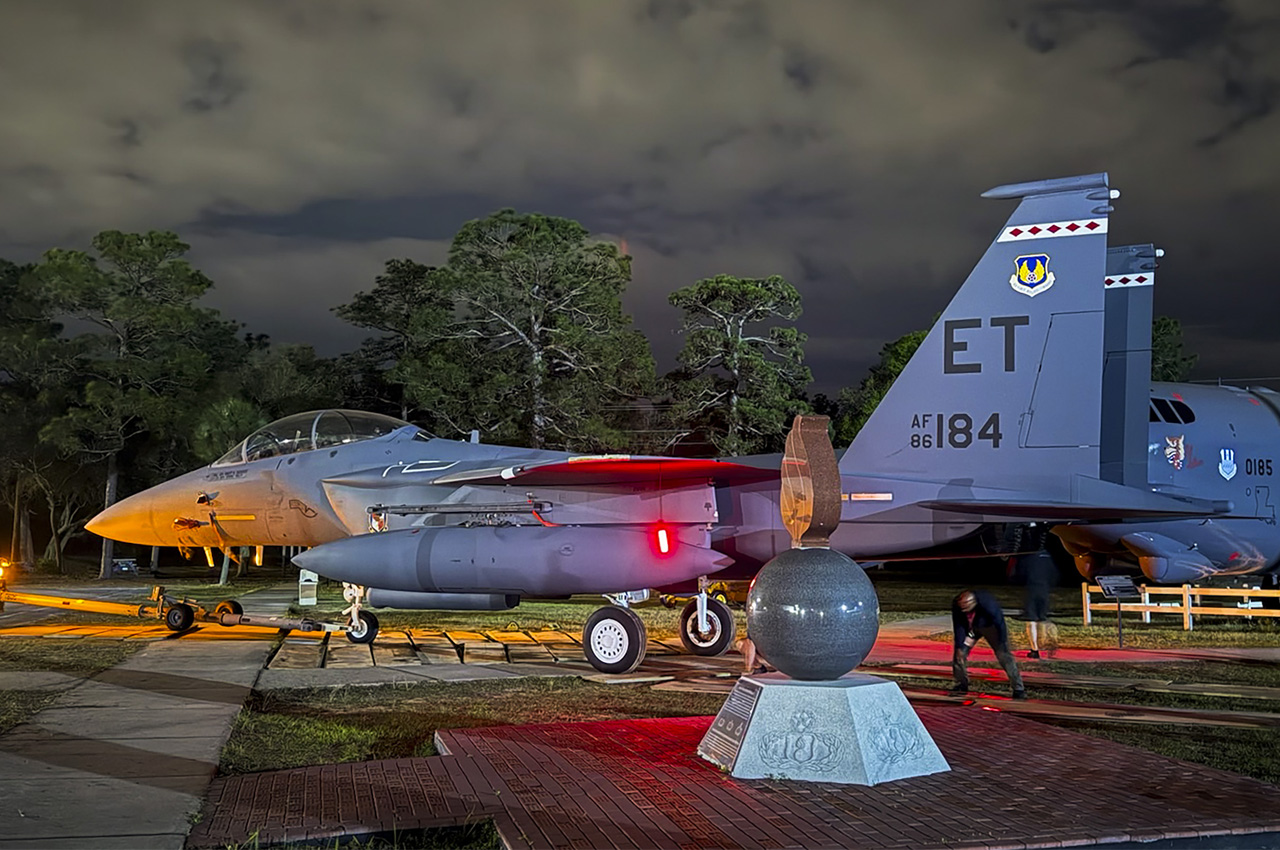
The Air Force Armament Museum will officially welcome F-15E Strike Eagle 86-0184 to its permanent collection during a public ceremony April 10 that will also honor the late Maj. Gen. Robert “ChedBob” Chedister, a former Air Armament Center commander whose work at Eglin Air Force Base shaped some of the most consequential precision weapons in the Air Force inventory.
- The ceremony begins at 9 a.m. at the Museum Event Area, located at 100 Museum Drive on Eglin Air Force Base. The event is open to the public. Chedister’s family will attend.
The Air Armament Center at Eglin was responsible for the development, acquisition, testing and deployment of all air-delivered weapons for the U.S. Air Force, including the Advanced Medium Range Air-to-Air Missile, Joint Direct Attack Munition and Small Diameter Bomb.
Chedister commanded the Air Armament Center from 2001 to 2005, a period of intense weapons development driven by the post-9/11 conflicts. During his tenure, the center developed, tested, purchased and fielded the Joint Direct Attack Munition, Small Diameter Bomb, Advanced Medium Range Air-to-Air Missile and the Massive Ordnance Air Burst weapon.
The MOAB was developed, tested and fielded by the Air Force Research Laboratory Munitions Directorate and Air Armament Center at Eglin in only nine weeks to be available for the 2003 Iraq campaign.
The Joint Direct Attack Munition converts free-fall bombs into all-weather precision-guided munitions through a GPS-aided inertial navigation system, allowing the weapon to autonomously navigate to pre-programmed coordinates once released from the aircraft. Boeing demonstrated the first JDAM for a 500-pound bomb at Eglin, and the first Small Diameter Bomb launch in the competitive development program also took place at Eglin when a Boeing SDB successfully separated from an F-15E.
Chedister, who passed away in May 2022, also served as president of the Air Force Armament Museum Foundation board.
The aircraft joining the museum’s collection is no ordinary Strike Eagle, according to Lt. Col. Ken Pickler, USAF (Retired), the primary event contact, who provided additional details about the airframe drawn from 96th Test Wing records and the Defense Technical Information Center.
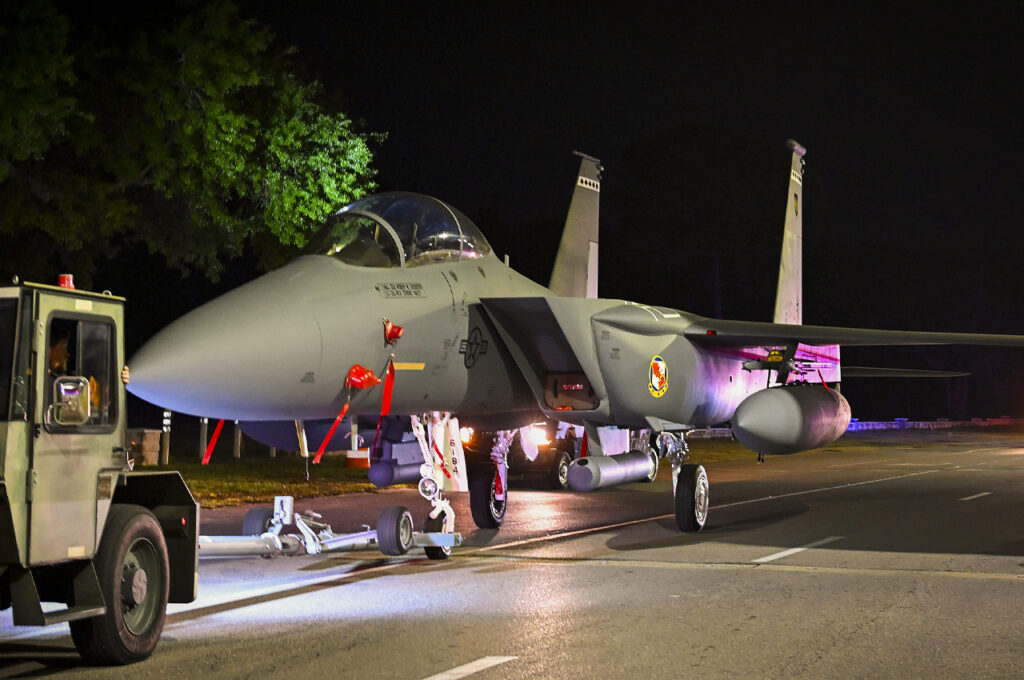
Serial number 86-0184, frequently identified as one of the oldest active Strike Eagles in the fleet, was originally on the F-15 production line as an F-15D before being modified as a prototype F-15E, according to Pickler. The jet was nearly designated YF-15E. Structurally and mechanically, the aircraft is essentially a D model from the rear cockpit bulkhead back, meaning its environmental control system, parts of its power generation and distribution system and the shape of the aft fuselage differ from a production F-15E.
Unlike standard combat-coded F-15 aircraft, 86-0184 spent its career in developmental testing, focused on ensuring new hardware and software was safe and effective for use by front-line squadrons. The aircraft served with the 412th Test Wing at Edwards Air Force Base in California and the 96th Test Wing at Eglin.
According to 96th Test Wing records and DTIC documentation provided by Pickler, the jet was instrumental in numerous weapons test programs and F-15 upgrade programs. It served as a primary test aircraft for the Small Diameter Bomb and also tested the Joint Direct Attack Munition family of weapons, the GBU-28 bunker buster, the GBU-53 StormBreaker and the Joint Air-to-Surface Standoff Missile family of cruise missiles.
- Its test history also included the AGM-158B Extended Range Standoff Missile operational deployment testing, advanced radar upgrades, weapon system software testing, the Radar Modernization Program and service as a demonstrator for the F-15SE Silent Eagle featuring a conformal weapons bay.
In March 2021, 86-0184 flew the historic Eagle Lineage flight alongside the F-15EX.
The aircraft was also vital in training the F-15E fleet for Operation Desert Storm, Operation Allied Force, Operation Enduring Freedom and Operation Iraqi Freedom, according to the records.
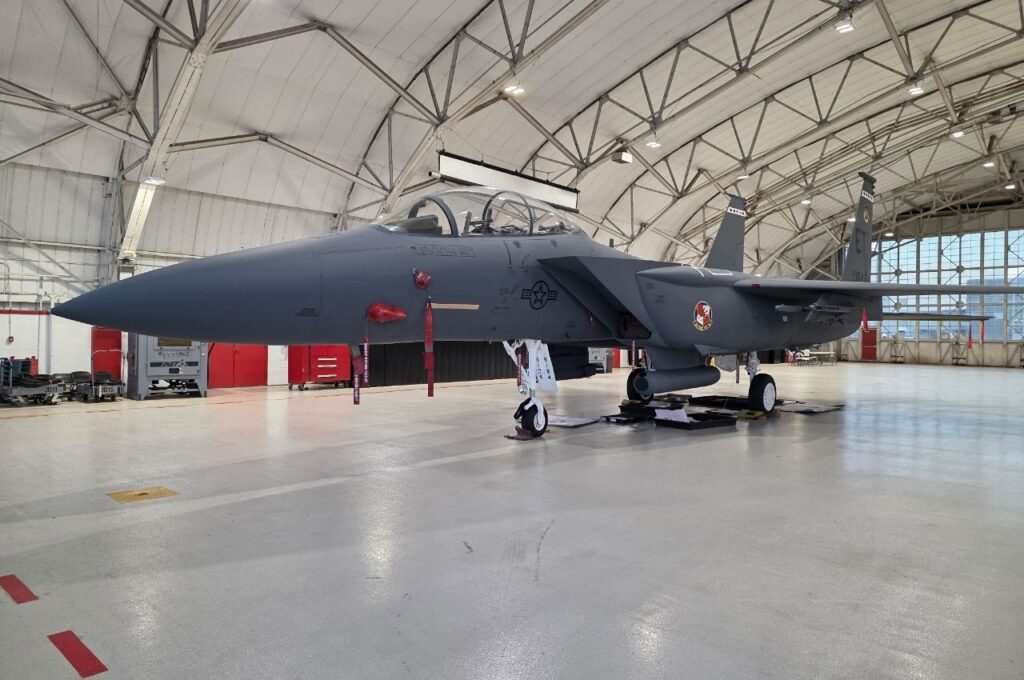
The F-15E Strike Eagle is a two-seat, dual-role fighter designed for all-weather, day-or-night air-to-ground attack while maintaining the air superiority capabilities of the original F-15 Eagle. Initially designed and manufactured by McDonnell Douglas, the F-15E first flew in 1986, entered service in 1989 and first saw combat during Operation Desert Storm in 1991. Production continued under Boeing following the companies’ merger in 1997.
The Strike Eagle is powered by two Pratt & Whitney F100-PW-220/229 engines producing 25,000 to 29,000 pounds of thrust each, is capable of speeds exceeding Mach 2.5 and can carry up to 23,000 pounds of payload.
The F-15 family holds a 104-0 air-to-air combat record, the most dominant kill-loss ratio of any jet fighter in history. F-15E Strike Eagles flew approximately 2,200 sorties in the Gulf War alone while delivering roughly 60 percent of all coalition precision-guided munitions.
The aircraft joining the museum’s collection will honor the airmen who flew and maintained it throughout its operational service.
A native of Hazen, Arkansas, Chedister entered the Air Force as a distinguished graduate of the University of Arkansas ROTC program, where he earned a bachelor’s degree in electrical engineering.
He later earned a master’s degree in electrical engineering from the Air Force Institute of Technology at Wright-Patterson Air Force Base and a second master’s in management from Troy State University. He also graduated from the Industrial College of the Armed Forces.
Chedister was a command pilot with more than 3,000 flying hours as a fighter pilot and test pilot, having flown the A-7, OV-10, F-4, F-16, F-15, F-117, C-12, T-38 and T-37. His military decorations included the Distinguished Service Medal, Legion of Merit with oak leaf cluster, Defense Meritorious Service Medal, Meritorious Service Medal with four oak leaf clusters and Air Force Commendation Medal with two oak leaf clusters.