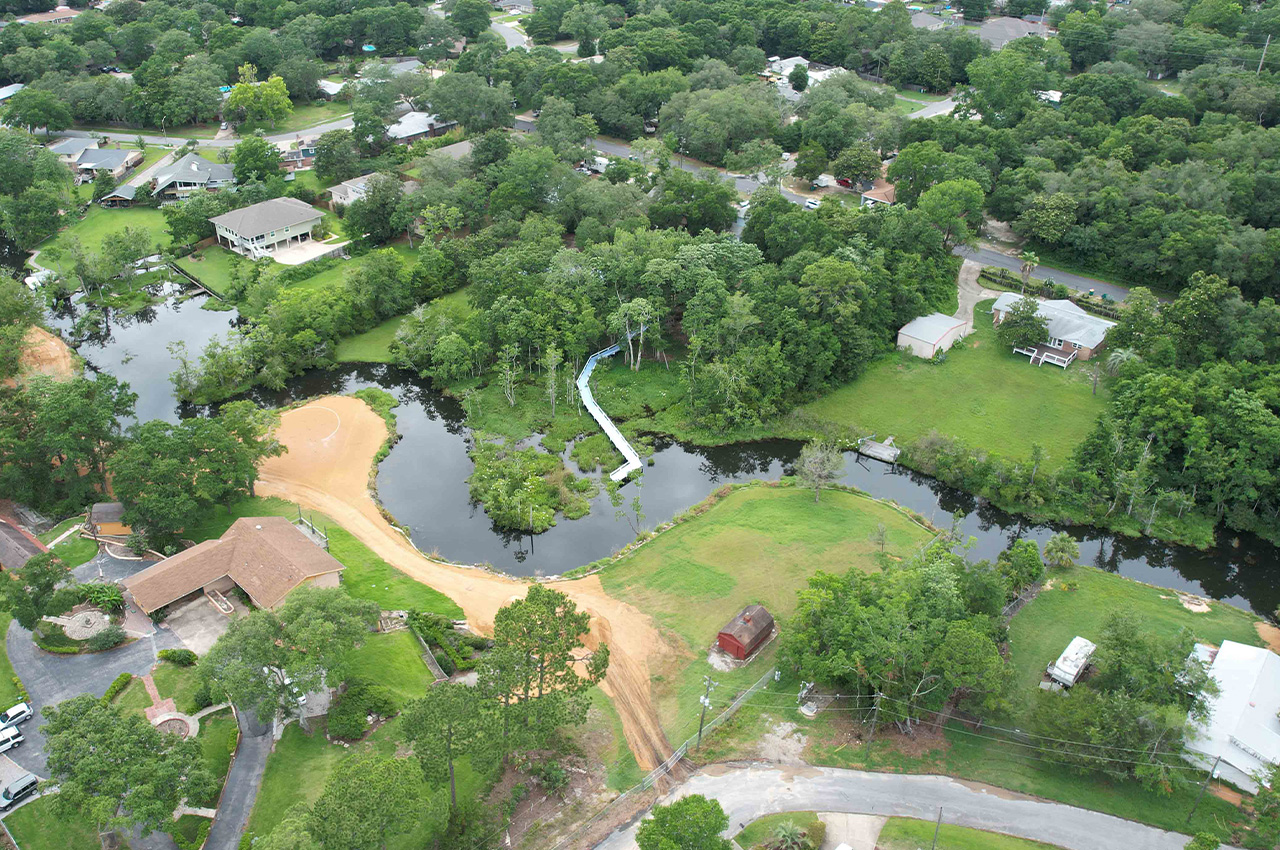
For more than 40 years, residents of a Fort Walton Beach neighborhood have endured reported chronic flooding, and civil rights leaders are demanding immediate intervention while county officials say they’re working to overcome complex regulatory obstacles.
- The Okaloosa County Branch of the NAACP released a comprehensive report Jan. 15 documenting what it describes as systemic environmental injustice in the Sylvania Heights and Lovejoy areas, where Gap Creek’s drainage has repeatedly damaged homes, threatened health and isolated families during routine rainstorms.
“Environmental justice is a civil rights issue,” said Sabu Williams, president of the branch, in a press release issued Jan. 20. “The families of Sylvania Heights have been forced to live with preventable flooding and infrastructure neglect for far too long. This is a systemic failure, and it demands immediate corrective action.”
The organization is proposing a community roundtable within 90 days that would bring together federal, state and local officials — including representatives from the U.S. Army Corps of Engineers, Eglin Air Force Base, congressional offices and county and city leaders — to develop a coordinated response.
Okaloosa County Commission Chairman Trey Goodwin said he welcomes the proposed roundtable but disputes some characterizations in the report.
- “I think the report simply demonstrates some of the community’s frustration about the situation,” Goodwin said. “We’ve done a lot of work as a county trying to improve the stormwater in the Gap Creek drainage basin.”
Goodwin said the drainage basin covers more than 2,500 acres, with water flowing from multiple communities including Hurlburt Field, Sylvania Heights, the Fort Walton Beach Commerce and Technology Park, Overbrook and the Northgate subdivision.
The county has upgraded several stormwater conveyance systems, improved pipes, outfalls and intakes, and expanded retention facilities, according to Goodwin. But the creek itself has suffered significant sedimentation from years of stormwater inflow and cannot be excavated or dredged without regulatory approval.
“That is something that is really going to be necessary to take stormwater management in the Gap Creek Drain Basin into the next step,” he said.
Multiple jurisdictions complicate the issue. The area involves county and city boundaries as well as state and federal oversight.
- “You’ve got the combined issues of needing Florida Department of Environmental Protection and Army Corps engineer permits,” Goodwin said. “And then you’ve also got portions of that creek that are overlaid by conservation easements that were granted many years ago in different phases, as those properties were developed over the past three to four decades.”
Residents have reported flooded homes and yards after routine rainfall, erosion threatening property foundations, standing water increasing health risks and mosquito exposure, blocked access to homes during severe weather, and repeated emotional and financial strain, according to the NAACP press release.
The 34-page report traces the neighborhood’s infrastructure problems to its origins in the 1950s and 1960s, when subdivisions were developed outside city limits without paved roads, stormwater systems or municipal utilities, according to the report. The first subdivision, platted by Sylvan Marlar in 1953, included 116 lots. Additional subdivisions followed through the 1960s as Fort Walton Beach’s population grew nearly fivefold between 1950 and 1960.
- By the 1960s, Sylvania Heights had become a predominantly African American neighborhood. Many families relocated from downtown Fort Walton Beach, often moving former military barracks onto residential lots as affordable housing.
The report contrasts conditions in Sylvania Heights with the nearby W.E. Combs neighborhood, which was annexed into Fort Walton Beach in 1977 and benefits from a dedicated municipal stormwater utility. According to the report, W.E. Combs has received steady infrastructure upgrades including an expanded retention pond, rain gardens and improved drainage systems.
Goodwin said the county has utilized some surtax money as matching funds for projects in the area, along with stormwater funds from the unincorporated county tax and leveraged grants. He said a large channel project for the Gap Creek drainage basin would be “ripe for a surtax project” and would fit the purpose for which the surtax was approved, but the county must first overcome regulatory hurdles.
The report states the existing drainage infrastructure in the area consists of a single 1.5-acre retention pond between Poplar Road and Hickory Road, which it describes as insufficient to manage watershed-scale runoff. According to the report, the county acquired additional land for a stormwater retention facility between 1997 and 2004, but the site remains undeveloped due to wetland permitting requirements.
Goodwin grew up in the area where the creek outfalls and has witnessed the changes over decades.
- “I’ve been in that creek in a John boat when I was 10 years old, and I’ve been in that creek with my children when they were 10 years old,” he said. “And I can tell you the difference between when I was ten and when they were ten is tremendous as far as how shallow that creek has become in certain places.”
The sedimentation affects not only flooding but also water quality, as the creek flows into the bayou and bay, Goodwin said.
According to the report, water quality testing has revealed that Gap Creek is impaired for E. coli and fecal coliform, with levels exceeding state thresholds. The Florida Department of Environmental Protection has designated Gap Creek as an impaired waterbody, triggering the requirement for a Total Maximum Daily Load plan to reduce bacterial contamination, the report states.
The report states that residents consistently report health issues they believe are linked to environmental conditions, including respiratory illnesses, chronic mold exposure, skin rashes, kidney disease and clusters of cancer diagnoses. While no formal epidemiological study has been conducted, the report notes these concerns are consistent with long-term exposure to contaminated floodwaters, aging septic systems and legacy industrial activity.
- “These issues have a greater impact on Black families and those with low incomes, highlighting ongoing inequities in resource distribution and delays in government action,” Williams said in the proposal letter.
In September 2025, the Okaloosa County Commission approved $250,000 in surtax reserves to match a state appropriation for a comprehensive watershed study. The Infrastructure Surtax Advisory Committee approved the allocation recommendation at its August 13, 2025 meeting.
The $500,000 project, conducted in partnership with the Florida Department of Environmental Protection, will assess the Gap Creek watershed between Jonquil Avenue and Beal Parkway, map the creek channel, document existing stormwater infrastructure, evaluate solutions and prioritize improvements for disadvantaged communities.
County Administrator John Hofstad told commissioners the system has been a problem for the 15 years he’s been with the county and predates his time when he worked for the city.
- ‘It greatly impacts the Lovejoy community. They’ve been after this project for some time,’ Hofstad said during the September meeting.
Goodwin said the study will gather data needed to navigate regulatory requirements for work in the channel itself, which he believes is key to making significant improvements.
“It’s not that the county is moving at a slow pace, it’s that the process forces us into a timeline that feels like a slow pace,” Goodwin said. “It feels like a slow pace to me, and I know that it feels like a slow pace to our Public Works staff and our Engineering staff who would love to be able to say, let’s design it and let’s go build it next year.”
The NAACP is calling for five specific actions:
- Commissioning a full, independent environmental and engineering assessment of Gap Creek and surrounding drainage systems.
- Implementing immediate mitigation measures including clearing blockages, stabilizing creek banks and repairing drainage infrastructure.
- Developing and funding a long-term infrastructure improvement plan with transparent timelines and public reporting.
- Ensuring equitable distribution of public resources, prioritizing historically underserved communities.
- Establishing a community oversight process that includes residents in decision-making and accountability.
The report does acknowledge long-standing efforts by community activists Barry Gray and Debi Riley, along with NAACP Environmental Justice advocate and immediate past president Lewis Jennings. It also recognizes ongoing work by Rep. Patt Maney, Okaloosa County Commissioners Trey Goodwin and Paul Mixon, Fort Walton Beach City Manager Jason Davis, and Kyle Blanchard, aide to Congressman Jimmy Patronis.
“While we recognize the challenges facing Gap Creek did not develop overnight and that remediation will require sustained time and effort, the urgency of this issue cannot be overstated,” the proposal states. “Continuing to address the creek in a piecemeal fashion, as has been done in the past, will not resolve the full scope of the problem. Such an approach risks leaving certain communities behind—not because of their health needs, but due to their economic status.”
Goodwin said he plans to participate in any conversations regarding Gap Creek flooding.
“Conversations have happened, and they are not over,” he said. “I welcome the opportunity for a roundtable. I’ll be there. I’ll have my county engineer there and we’ll be ready to participate and work with the stakeholders, the community members and other government officials to see what we can come up with. Every resident that lives out there – that is a county constituent or a city constituent – they all have a reasonable expectation for their local governments to fight for them for stormwater management to make sure their homes are safe and secure.”