
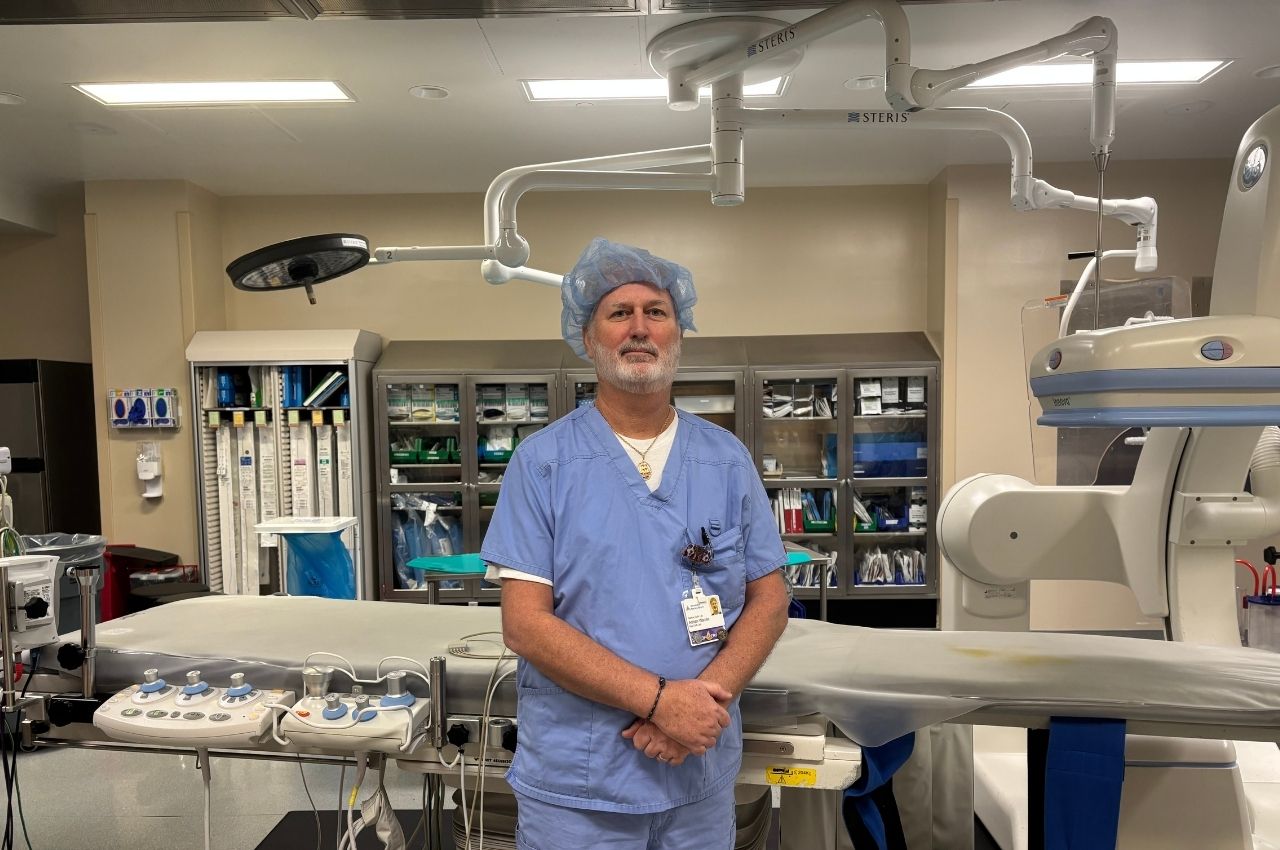
Adrian Warren has spent 25 years helping save the lives of heart attack patients. On one ordinary Tuesday morning, his own team had to save him.
- Warren, the cardiac catheterization laboratory manager at Ascension Sacred Heart Emerald Coast, was walking down a hallway with two cath lab nurses when he suddenly felt overwhelmed by weakness. Within seconds, he collapsed into cardiac arrest — the result of a complete blockage in his left anterior descending artery, commonly known as a “widow maker.”
It was about 10 a.m. He had eaten breakfast, started his shift and felt perfectly normal. Then, without warning, everything changed.
“I went from feeling perfectly normal to ‘I’ve got to sit down right here in this hallway,’” Warren said. “I told the nurse I was with that I didn’t feel good — and then I just went out.”
He estimates he had roughly 20 to 30 seconds of warning before losing consciousness.
Nurse Mark, one of the colleagues walking beside Warren, lowered him to the floor to prevent a head injury. A crash cart happened to be just five feet away. Staff called a code, and the hospital’s emergency response team mobilized immediately.
- Warren required three defibrillator shocks to restore a normal heart rhythm. He was rushed to the emergency room, where Dr. Ramesh Brahmbhatt, an interventional cardiologist, was already waiting.
“Adrian’s story is very unique,” Dr. Brahmbhatt said. “He sustained a sudden collapse and cardiac arrest in the vicinity of the cardiac catheterization laboratory. He had prompt resuscitation by his colleagues and he regained his heart rhythm and consciousness.”
Dr. Brahmbhatt performed an emergency heart catheterization and confirmed what the electrocardiogram had already suggested: Warren’s left anterior descending artery was completely blocked. The team opened the artery and placed a stent.
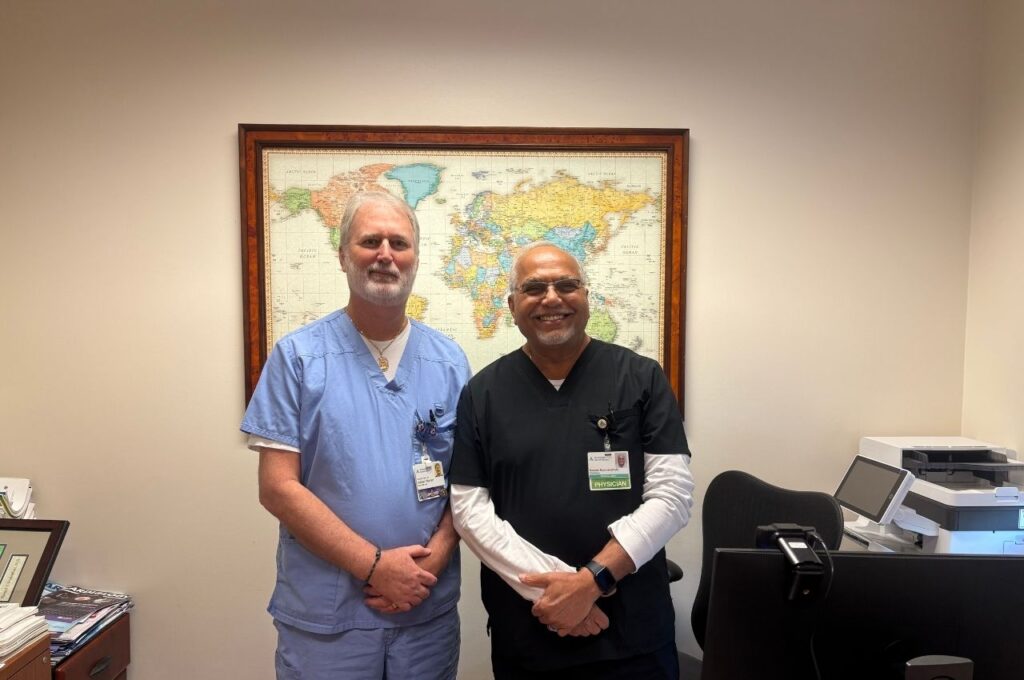
The result was remarkable. Warren’s electrocardiogram returned to normal. He sustained zero damage to his heart muscle.
“I think it teaches us a lesson that being at the right place at the right time when you have a heart attack is very critical,” Dr. Brahmbhatt said.
Why they call it the ‘Widow-maker’
The left anterior descending artery runs along the front of the heart and supplies blood to a large portion of the heart muscle. When it becomes completely blocked, the resulting heart attack is often massive, severe and potentially fatal.
- “If there is a blockage in this artery, the heart attacks are much more massive, much more severe and much more complicated because it can damage quite a bit of the heart muscle,” Dr. Brahmbhatt explained. “Sometimes the heart will go out of rhythm, which is a sudden loss of consciousness and cardiac arrest — the heart doesn’t pump.”
That is exactly what happened to Warren. His heart went into a ventricular fibrillation, a dangerous rhythm in which the heart quivers instead of pumping blood effectively. Without the immediate defibrillation he received from his colleagues, the outcome could have been very different.
On the other side of the table
For Warren, the experience carried a surreal twist. He has spent his career managing the very cath lab where he found himself as a patient, lying on the table surrounded by his own staff.
- “While I was awake, it was scary, but I felt like I was in good hands,” Warren said. “The funny thing is, I’d always told my wife, ‘If I ever have an emergency, I sure would like to have Mark by my side.’ And he’s the one who actually lowered me to the floor.”
Warren had no chest pain throughout the entire event — even after the defibrillation restored his rhythm. Despite 25 years in cardiac care, he had no idea he was having a heart attack until Dr. Brahmbhatt told him.
“I was surprised by the whole thing,” Warren said.
He had no family history of heart disease. His only known risk factor was high cholesterol, which he had managed with statin medication for years. His levels
‘Time Is Muscle’: What the public should know
In cardiology, there is a saying: “Time is muscle.” Every minute that passes after the onset of a heart attack means more heart muscle is dying. That damage becomes permanent, forming scar tissue that can weaken the heart over time and lead to congestive heart failure.
- Ascension Sacred Heart Hospital Emerald Coast maintains an average door-to-balloon time — the interval from a patient’s arrival to the moment the blocked artery is opened — of under 60 minutes, well below the national standard of 90 minutes.
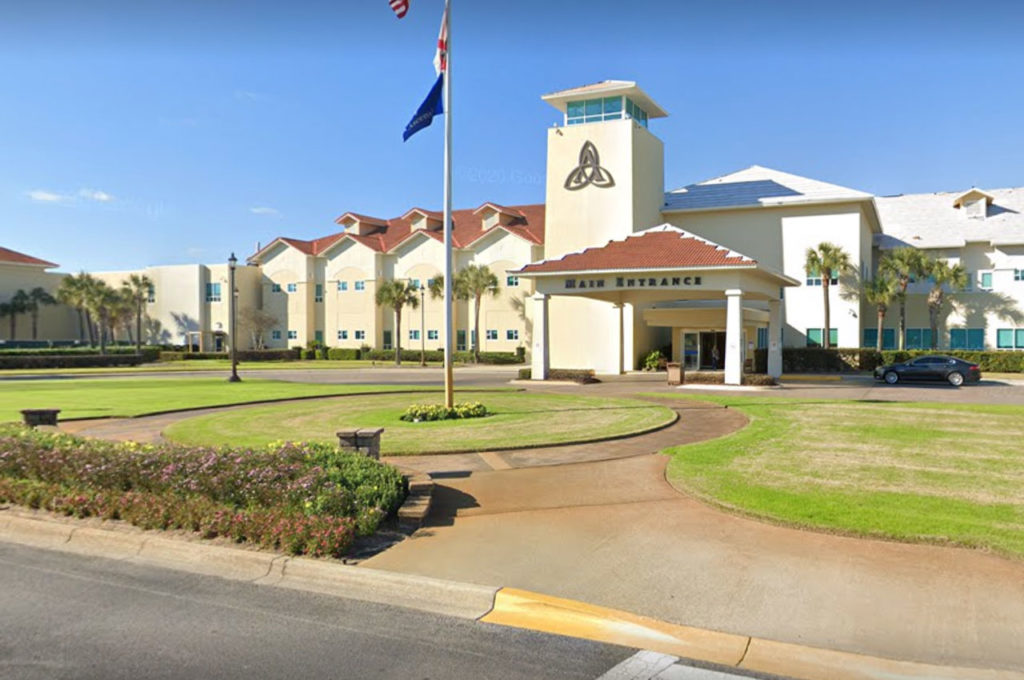
When patients call 911, EMS teams are trained to perform an electrocardiogram in the field and, if they detect signs of a heart attack, transmit it directly to the emergency department. The hospital’s STEMI team — a specialized group that responds to ST-elevation myocardial infarction events — can be activated before the patient even arrives.
“When a patient experiences heart attack symptoms, the most important thing is that they call 911 promptly,” Dr. Brahmbhatt said. “A lot of times, patients mistake their symptoms for acid reflux or indigestion.”
Inside the hospital’s emergency response
Warren’s case highlights a lesser-known aspect of hospital preparedness: the response to emergencies that happen inside the building. Whether a patient, visitor or staff member experiences a medical crisis within hospital walls, a code team responds within minutes.
- “Everybody that’s on the code team responds,” Warren said. “I can’t say enough about this hospital and this team and how they’re prepared. Everything just went like clockwork.”
For inpatient emergencies, the response is even faster, according to Dr. Brahmbhatt. A critical care team is on call around the clock, and the cath lab team can be assembled and ready within 20 to 30 minutes, even outside normal operating hours.
Dr. Brahmbhatt, who trained at the Cleveland Clinic before joining Ascension Sacred Heart Emerald Coast four years ago, said he has treated another colleague in the past — a surgeon who went into cardiac arrest while performing an operation.
“His partner took over the surgery, and I had to take him to the cath lab,” Dr. Brahmbhatt recalled. “That’s why being at the right place at the right time is so important.”
Know the warning signs
Dr. Brahmbhatt urged residents across the Emerald Coast to familiarize themselves and their families with the symptoms of a heart attack. The classic signs include severe crushing chest pain that may radiate to the arms or jaw, profuse sweating, and nausea or vomiting.
- However, he emphasized that many patients — particularly women — present with atypical symptoms such as shortness of breath, sudden fatigue or a breakout in sweat without the characteristic of chest pain. Warren’s case is a striking example: he experienced none of the classic symptoms and instead felt only sudden overwhelming weakness.
Dr. Brahmbhatt also stressed the importance of prevention. He noted that among all patients who arrive at the hospital with a heart attack, roughly half had no symptoms beforehand. The underlying blockage existed, but it was silent.
“Prevention is always better than cure,” he said. “If you have risk factors — hypertension, diabetes, high cholesterol, smoking — even if you don’t have symptoms, it’s very important to get periodic evaluations with your physician, including blood work, stress tests or imaging studies like a coronary calcium score.”
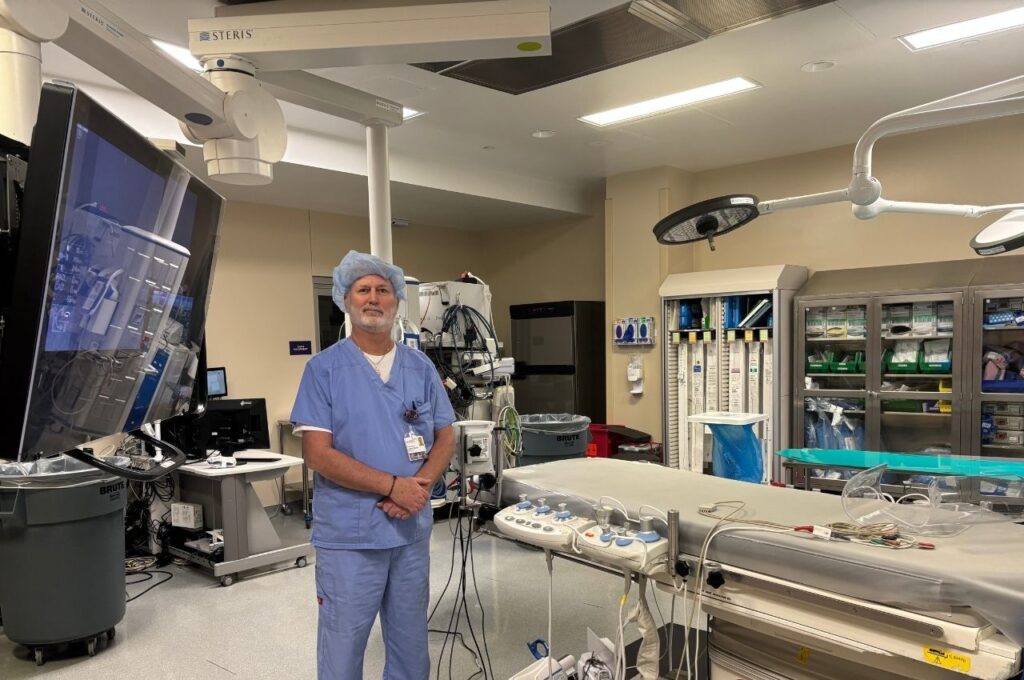
Both Warren and Dr. Brahmbhatt emphasized a message that extends beyond the hospital’s walls: bystander CPR saves lives.
- Dr. Brahmbhatt said he has treated patients who suffered cardiac arrest on golf courses, tennis courts and beaches along the Emerald Coast. Those who received prompt CPR from bystanders had significantly better survival outcomes.
“For the general community, it’s very important that people get basic life support or CPR training so they can help someone nearby who has suffered cardiac arrest,” he said. “We have several success stories where people survived because they got very prompt CPR.”
Back on his feet
Warren is now back at work and nearing graduation from cardiac rehabilitation, a program he has attended three times per week to rebuild his strength, learn new exercise habits and refine his approach to heart-healthy living.
- “When you have symptoms, get checked out,” Warren said. “Get to the hospital. If it would’ve happened anywhere else, the success story I have is not always there for people. The longer it takes to get your arteries open, the more muscle you lose — and you can’t get that back.”
He also spoke about Dr. Brahmbhatt with deep gratitude.
“He’s so personable and cares about his patients,” Warren said. “They told me that when they called him and said I was going to the ER, they’d never seen anyone move so fast. He met us there as we rolled in. He’s a great doctor and a great friend.”
February is American Heart Month. To learn more about recognizing the signs of a heart attack, finding CPR training in your area or understanding your heart disease risk factors, talk to your primary care physician or visit heart.org.


One Response
I felt Adrian’s experience in a very personal way, too. I also was a cardiac cath lab tech at Fort Walton Beach Medical Center before I retired in 2021. I was just getting ready to start monitoring our next heart cath patient when I felt a giant hand begin to crush my heart. I found it difficult to breathe but thought in my head “I can make it through this case.” But then the voice of reason shouted, “You’re having a heart attack, dummy! Don’t try to tough it out, you idiot!” And like Adrian Warren, I had all the right people around me to help me in that situation. I always knew it would come in handy working in the cath lab if I ever had a heart attack!