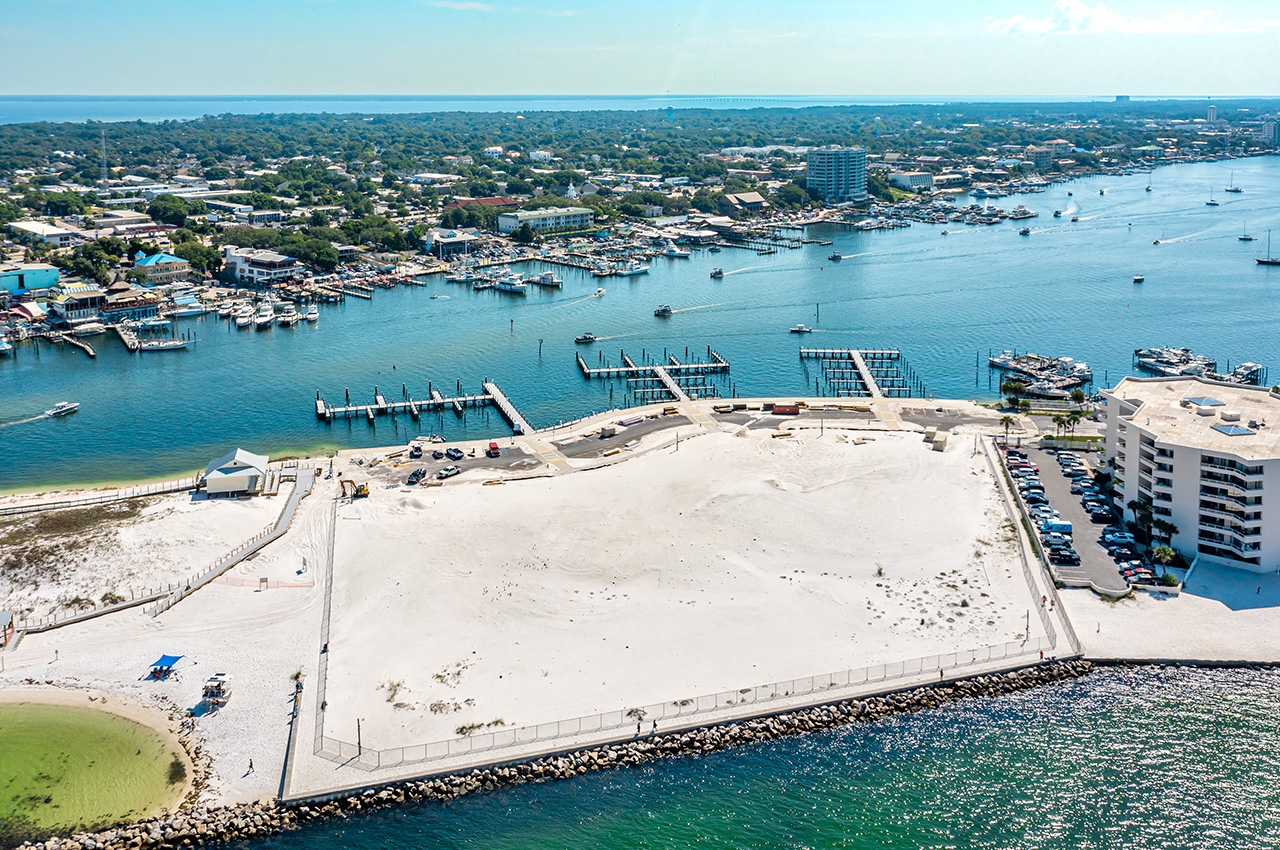
The Destin City Council on Monday, Nov. 2, approved a 50-year lease with the state for approximately 4 acres of state-owned land on Holiday Isle, adjacent to the city’s Norriego Point Park.
- The 6-0 vote, with Councilman Rodney Braden absent, came on a motion by Councilman Kevin Schmidt, seconded by Councilwoman Teresa Hebert. In two additional 6-0 votes, the council authorized city staff to work with the state on a management plan for the property and directed staff to return Nov. 16 with a schedule for public input.
The lease is between the city and the Board of Trustees of the Internal Improvement Trust Fund of the State of Florida, which holds title to the property. The board’s responsibilities under the lease are delegated to the Division of State Lands within the Florida Department of Environmental Protection.
City Attorney Kim Kopp told the council the lease would be for the purpose of “conservation, protection of natural and historical resources, and compatible resource-based public recreation and education, and related uses specifically designated in an approved management plan.” The city would pay the state a $300 annual administrative fee.
The lease covers the upland portion of the property. According to the city’s agenda item, it does not authorize use of the docks, which would be handled through a separate sovereign submerged lands lease.
“Going back really quickly to the management plan, that’s where all of the details, of course, with respect to the future use of the property will be contained,” Kopp said. “We’ll work with DEP with that. We’ve already sent them your preliminary ideas, and they hadn’t expressed any objections. Other than that, it’s a pretty standard lease.”
Under the lease, the city must submit a draft management plan to the state within 10 months of the lease’s effective date, and DEP must be given the opportunity to participate in all phases of its preparation. The property cannot be developed or physically altered, other than for security and maintenance, until the plan is approved. The plan must also emphasize the original management concept approved when the state acquired the property.
- According to the agenda item, the city assumes responsibility for essentially all costs of operating and managing the property. The lease also gives the state the right to terminate it at will, for any reason, with six months’ notice.
Mayor Bobby Wagner said he wanted to keep the process moving but was cautious about treating the lease as final before every signature is in place.
“Until the governor signs or whoever needs to sign this thing, it’s not a done deal until it’s a done deal in my head,” Wagner said. “This is step one, but it is still not under our purview until that management agreement is signed.”
Schmidt asked whether the city would hold the lease once it is signed. Kopp said DEP’s legal counsel had already signed the lease before sending it to the city. The DEP attorney’s approval on the document is dated Oct. 29.
“The mayor will sign tonight now that you’ve approved it, but it still has to be signed by Mr. Richardson at DEP,” Kopp said. “So we’ll give him the copy signed by the mayor, and then we’ll get it back … fully executed. Then we will have the lease once he signs.”
Brad Richardson, Chief of the Bureau of Public Land Administration in DEP’s Division of State Lands, signs on behalf of the Board of Trustees, according to the lease. Kopp said the 10-month window for the management plan begins once the lease is fully executed, and the plan must also be approved by the state’s Acquisition and Restoration Council, which she said meets only a certain number of times a year.
Public input schedule
Wagner asked the council how quickly it wanted to begin scheduling meetings, noting that the December holidays can complicate calendars. Hebert moved to bring the item back at the council’s next regular meeting, Nov. 16.
Schmidt suggested staff instead return with a schedule covering the next six to seven months of meetings.
- “I think it’s too early to start talking about the plan on November 16th,” Schmidt said.
Hebert said her intent was for staff to bring back the meeting schedule and how public input would be built into the process, not the plan itself. Wagner described the Nov. 16 item as “a plan for the plan.”
Councilman Dewey Destin said the discussion answered his question about public involvement.
“I was questioning the fact that I didn’t hear anything about public input, but it sounds like we will have it when we get the plan for the plan,” Destin said.
City’s preliminary concepts
The city outlined its preliminary concepts for the property in a Sept. 24 letter from Kopp to Richardson.
Proposed uses in the letter include extending the Norriego Point boardwalk around the perimeter of the state property, shade structures and gazebos, beach volleyball, a kayak launch, a fishing pier, a water taxi stop, dinghy docks, vertical oyster gardens and retrofitted docks with fee-based transient day-use slips.
The letter also proposes about 54 additional parking spaces on the state property, which would bring total parking at the site to more than 100 spaces, including 49 existing spaces on city-owned property. The city anticipates paving approximately one acre of the state property, leaving about three acres unpaved, according to the letter.
The letter estimates capital improvement costs of $3 million to $4 million and anticipated net revenue of about $820,000 a year from parking and transient docking fees, including a proposed $5 per hour rate for transient slips. It states that the city’s Parking Special Revenue Fund, which the council designated on Sept. 23 exclusively for Norriego Point and the state property, holds about $4 million.
The Okaloosa County Board of County Commissioners voted unanimously Sept. 16 to support the city’s request, according to the letter.
The council will take up the public input schedule at its Nov. 16 regular meeting.