
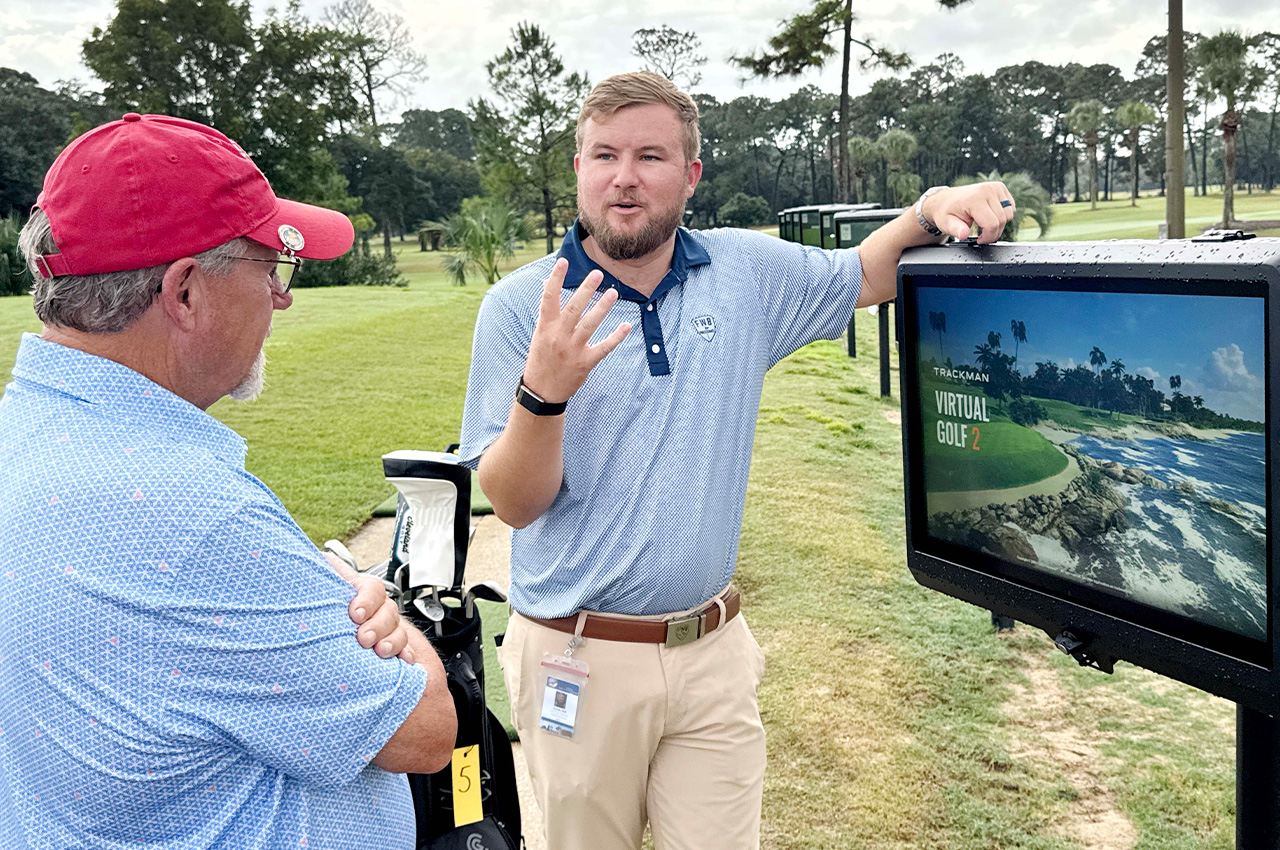
The Fort Walton Beach Golf Club’s revenue is up an average of 23.2% compared to the same 10-month period in each of the previous three fiscal years, Golf Director Jacob Hill told city council Tuesday night. The course is currently operating more than $300,000 in the black.
- Hill’s presentation during the Aug. 25 meeting highlighted growth driven by the addition of a Trackman driving range, increased memberships and an expanded merchandise operation.
The club has generated $2.54 million in revenue through July of fiscal year 2026, compared to $2.16 million during the same October-through-July window in fiscal year 2023.
Driving range revenue alone has nearly tripled in that span, climbing from $141,158 in FY23 to $380,430 in FY26. Memberships grew from $156,728 to $223,734 over the same period.
“People wear that,” Hill said of the pro shop’s merchandise growth, noting he received an email asking where to buy a hat that Councilman David Schmidt was wearing during a council meeting. “I actually got an email a couple weeks ago asking, ‘Hey, where can I buy the hat that Mr. Schmidt was wearing on the city council meeting?‘”
Hill also told council the club has tracked nearly 9,900 unique customers since implementing a new software system in April, with zip code data showing visitors from across the country.
New revenue on the horizon
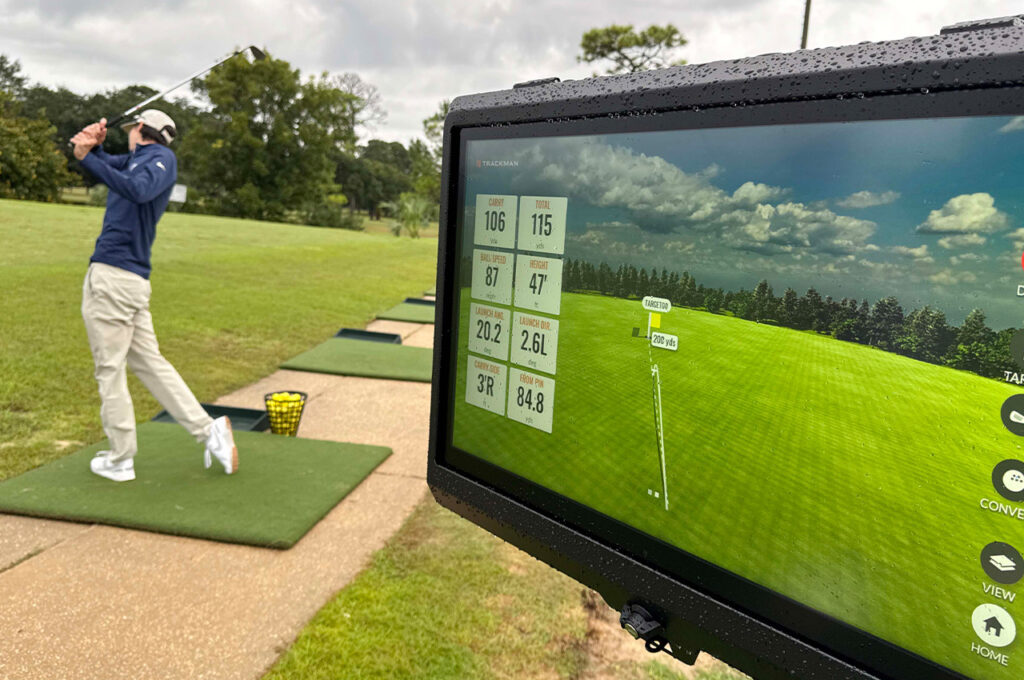
Hill said the club will reopen the former Edwin Watts space in the clubhouse this winter as “The Performance Center,” a facility featuring five TrackMan iO simulators funded by the Okaloosa County Tourist Development Council.
“Now for something really exciting,” Hill said. “This will bring in an estimated $300,000-$600,000 in revenue just from bay rentals.” That figure does not account for additional merchandise sales, leagues or clinics.
The club also recently landed the District 1 FHSAA district and regional golf tournaments, which Councilman Bryce Jeter said would bring hundreds of visitors to the area.
“Teams with five or ten kids on it, golf is kinda like baseball. They travel with their parents and their grandparents,” Jeter said. “So you’re talking a week long of hundreds of people coming and spending money and reinvesting back in the community.”
Capital requests and aging equipment
Hill presented two capital requests totaling $880,000, with the city’s share at $440,000 and the TDC covering the remaining half.
The first is a new golf cart fleet equipped with GPS technology. The GPS system would allow staff to geo-fence sensitive areas like greens and wet zones, automatically stopping carts that enter restricted spaces. Hill said it would also improve maintenance efficiency by eliminating the need for crews to manually set up and remove ropes and signs before mowing.
The carts would also increase cart fees from $20 to $32, which Hill said brings the rate closer to industry standard. The upgrade is projected to generate approximately $360,000 in additional annual revenue.
The second request is for new maintenance equipment. Hill told council the club maintains 360 acres and 36 holes with a crew of just 14, roughly what a mid-level 18-hole course would employ. The median age of the club’s current equipment is model year 2015, with 25% of it dating to 2008 or older. Hill pointed to one mower with 5,549 hours on it, the equivalent of roughly 500,000 miles on a car.
Council rallies behind growth, but debate emerges
Schmidt highlighted the revenue growth, pointing to the driving range’s jump from $141,000 to $380,000 and membership gains of roughly $80,000 per year.
- “It’s only been two short budget processes that you’ve been a part of, and you can tell the tremendous growth of changing that environment,” Schmidt told Hill. “Those folks who don’t play golf, that expect the potholes and the parks and all those things to be taken care of, these numbers really mean something.”
Jeter noted the golf course is now generating profit rather than costing taxpayers money, and that the $440,000 capital request is essentially the course asking for its own earnings back.
“You’re just asking for your money back that you made to invest in the golf course. You’re not asking for tax dollars,” Jeter said. “Run the city like a business. You’re just wanting to reinvest back into your business.”
The council has been moving the golf course toward an enterprise fund model, which would allow it to operate more independently and take on its own financing. Schmidt outlined the timeline: a special revenue fund by Oct. 1, 2026, a more restricted fund by Oct. 1, 2027, and full enterprise fund status by 2028.
City Manager Jason Davis confirmed that once enterprise funding is in place, the golf operation could secure its own loans and financing without drawing from the general fund.
Walker pushes privatization question
Councilman Payne Walker took a different approach, referencing a 2019 study the city commissioned from municipal consultant Quint Studer. Walker said the report identified the golf course and the city cemetery as “two non-core services” and recommended the city consider selling, outsourcing or reducing them when finances get tight.
“His opinion was there are two services identified as non-core services,” Walker said, quoting from the report. “When finances get tight, the long-range plans for the golf course need to be considered. These can range from selling, outsourcing, to possibly reducing it.”
Walker also asked Finance Director Nicole Nabors to verify a claim that the golf course has cost taxpayers $5 million over the past 12 years, and noted that the $440,000 capital request comes from the general fund.
- “Revenue increase to the government body is different than a revenue increase to taxpayers,” Walker said. “When taxpayers get it off of their back through privatization, the money that comes into the government is through leasing the property to a private organization, profit sharing, plus we don’t have the capital expenses ever on us.”
Walker told Hill he supports his work but believes the course should ultimately be privatized, and encouraged Hill to form a group and bid on it if it ever goes out for bids.
Davis pushed back on the Studer report, calling it six-year-old data.
“I am open to bringing Mr. Studer back. I could throw money at something like that. $200,000 to tell me that we’re doing really good, right? We can look at our own data,” Davis said, adding that council had directed him to pursue the enterprise fund model.
Jeter pushed back more directly, saying the Studer report no longer reflects the golf course’s financial reality.
“Times have changed. Our golf course did not used to have Jacob, it did not used to have these fees and everything it has now,” Jeter said. “If we were in here 10 years ago and the golf course was losing a million dollars a year, and we had revenues down and this cap over our head, and we rolled back the millage rate years in a row and our savings accounts being depleted, and we got these November cuts, I’d be the first one going, ‘Sell the golf course.’“

Jeter added that privatizing the course would also cut off access to TDC funding in the district. “But I think it’s really truly flipping how the golf course is where our profit is coming from, and that’s what we need to feed,” he said.
Schmidt said the golf course’s finances are “night and day” compared to 2019 and that the Studer report did not include a detailed analysis of the golf operation.
“I respect Mr. Studer, but I was here during that time of the study, and in this report, it wasn’t digested over golf data,” Schmidt said. “It was just a general statement, especially with what our budgets were showing in public records at that time. Golf wasn’t too healthy. These numbers are tremendously different.”
Looking ahead
Councilwoman Debi Riley asked Hill whether the golf course could sustain its current trajectory over the next two years.
“Yes,” Hill said. “Next year we’ll have a huge increase, especially with us getting the indoor Trackman system as well. Everything that we’re doing right now, I plan to keep it continuing to grow, but then adding those extra streams too, it’s just gonna keep going.”
Riley said she supports the direction. “Anything that’s self-sustaining, I’m loving it,” she said.




4 Responses
I love that the golf course is doing well, but I wonder if we are pricing out local players. A 50% increase in cart fees is pretty steep and would be more than other clubs.
Curb your enthusiasm:))! Cart fee increase of 60% is a little much! Lest we forget; the land is from the US Air Force and stipulates must be for recreational use , the TDC donated $800k+ for Pines Greens, the golf course is a public amenity used by a large number of military veterans and an economic demographic predominant to the FWB city and surrounding area. The council speaks about running the city like a business but I don’t see any move to reduce headcount at city hall. Essential services and Quality of Life should be at the forefront of every issue before the council. It would also be very helpful if our city, county, state, Federal representatives would would work together for the benefit of our area.
How do you equate a cemetery with a golf course operation? What am I missing? Also, privatization is an exit strategy used by voices that have limited or lack business operational knowledge. Political appointees need to support and encourage smart business growth. Let your business managers make business decisions and if they fail, correct the mistake/s and move forward. Just remember your customer base and what you gain from loyalty.
Member ship rates are going up again in 2027. But only a 25% increase.