
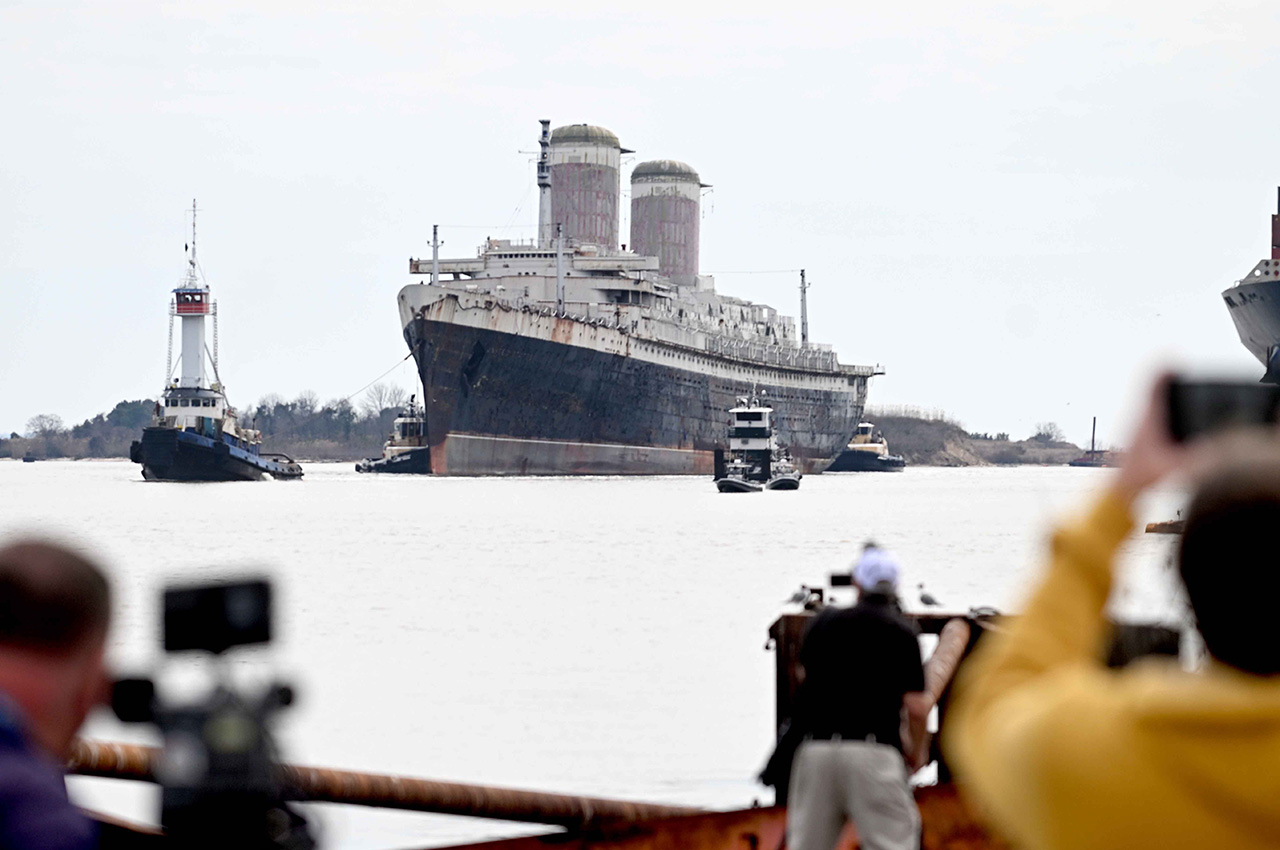
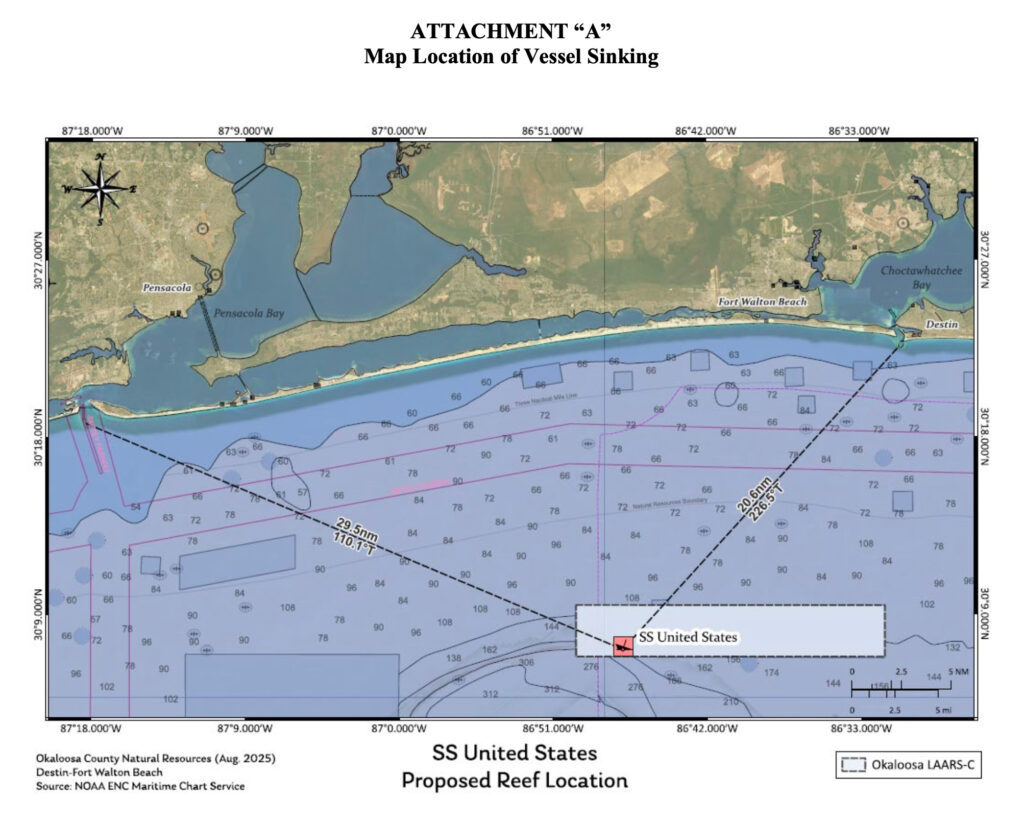
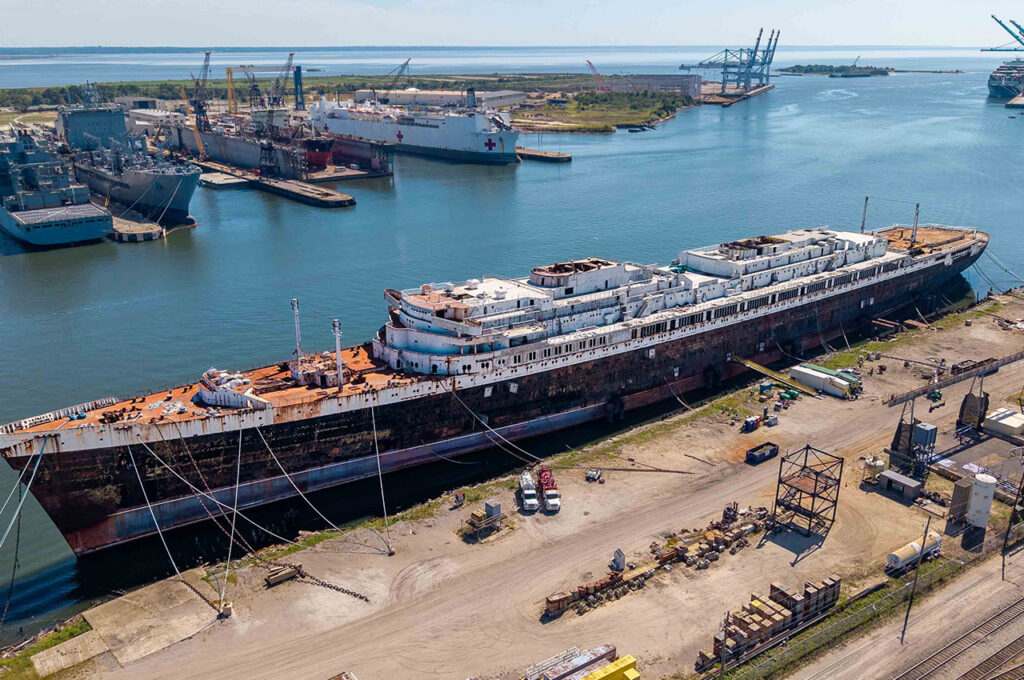
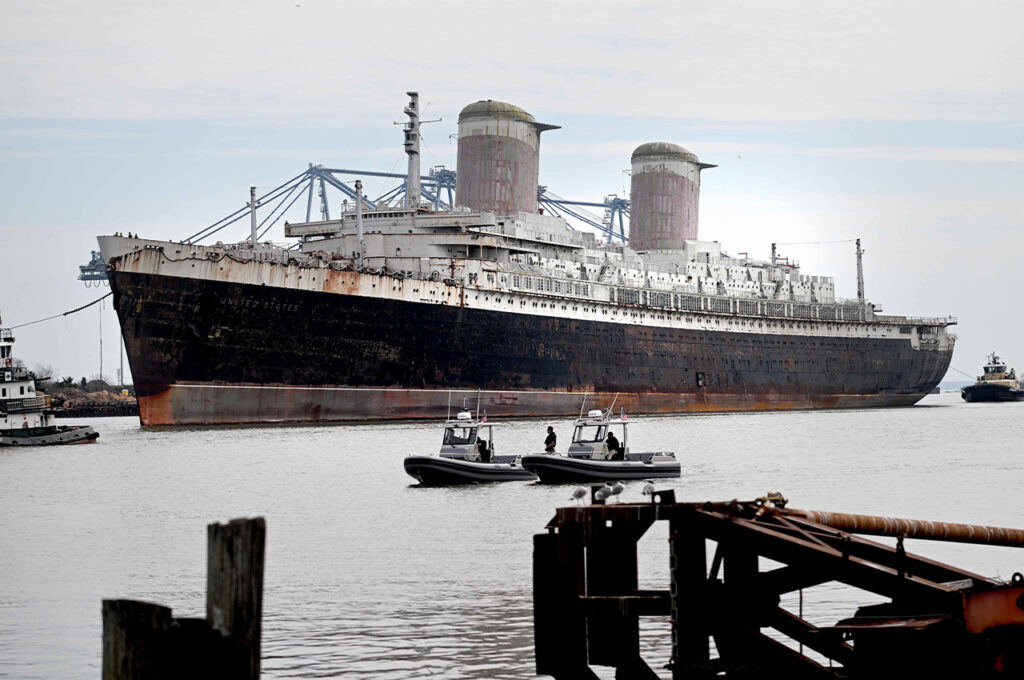
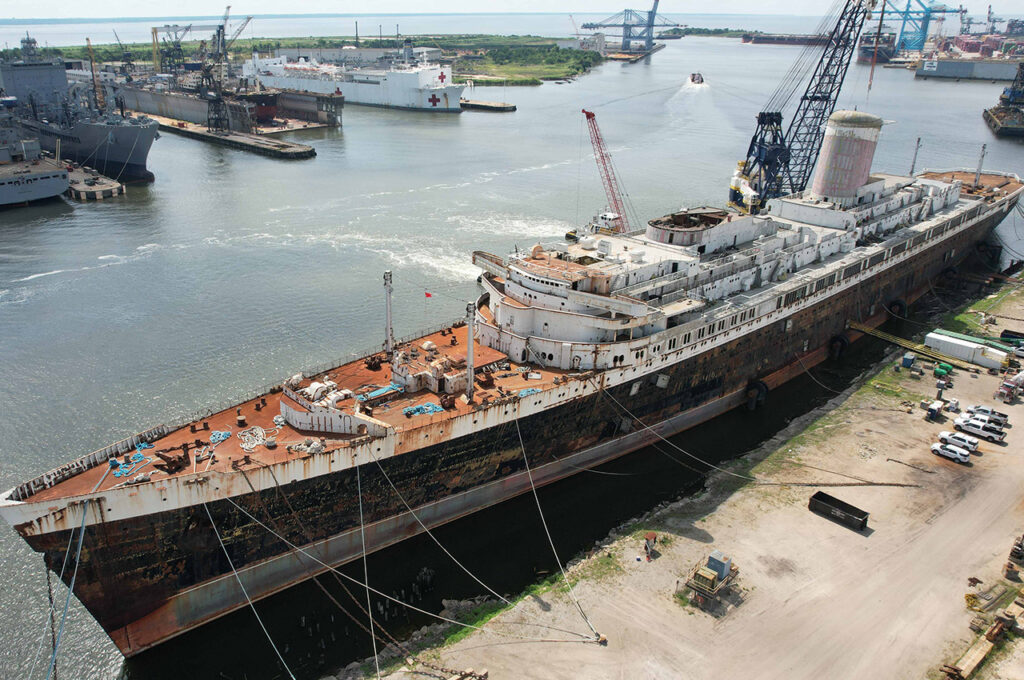
A team from Woods Hole Oceanographic Institution will be among the first in the water after the SS United States is deployed as an artificial reef off the coast of Destin-Fort Walton Beach, launching a long-term study to track how an entirely new ecosystem takes shape from the moment the 990-foot vessel reaches the seafloor.
- The research project, led by WHOI scientist Dr. Kirstin Meyer-Kaiser, represents what she describes as a once-in-a-career opportunity. There are roughly 3 million shipwrecks worldwide, but scientists almost never get to study one from the very beginning.
“Every time a ship sinks, it is a brand new habitat falling out of the sky,” Meyer-Kaiser said. “Usually when we do research on those, we find them years, decades, maybe even centuries after they have arrived on the sea floor. So in order to understand how what we observe took shape, there’s a lot of interpolation, there’s a lot of guesswork.”
The SS United States deployment changes that. Meyer-Kaiser and her team will establish what she calls a true baseline, not the ecosystem as they found it, but the ecosystem as it began.
“This is going to be the first time that anyone’s gonna be able to do that at this scale for such a large vessel, to be there right from day one when it’s sinking,” she said. “It’s an incredible opportunity.”
132 monitoring points
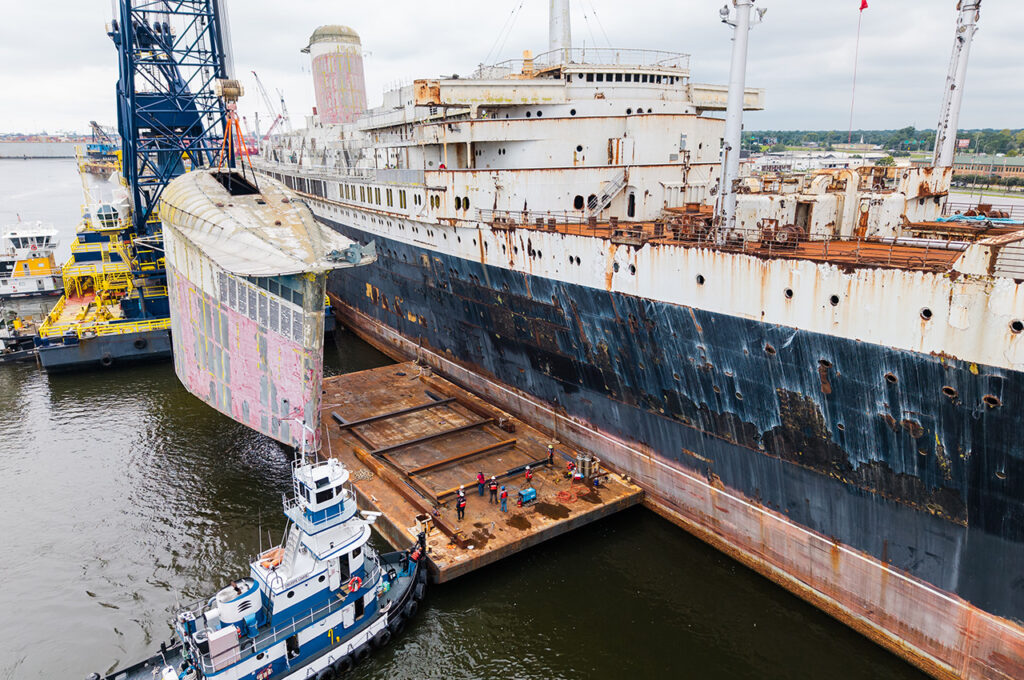
Meyer-Kaiser has developed a schematic of approximately 132 permanently tagged locations across the vessel. She provided Okaloosa County Natural Resources Chief Alex Fogg with cattle tags during a visit to the ship in Mobile, Alabama, in December, with instructions to mark those locations before deployment so researchers can return to the exact same spots over time and document changes.
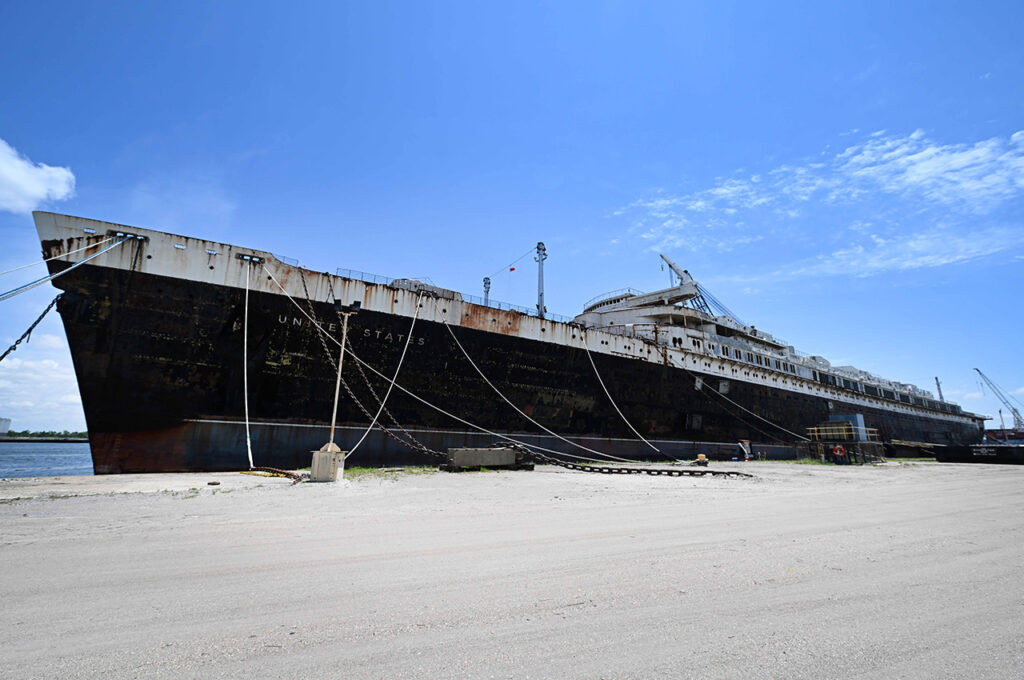
The research is structured around three interconnected areas of study, what Meyer-Kaiser describes as the three vertices of a triangle: water chemistry, microbiology and invertebrate communities.
- “We’ll collect water samples to see what the ship is contributing to the surrounding water layer,” she said. “The microbes that are living on the ship itself and maybe contributing to chemical changes like redox reactions. And then we’ll have photos and settlement panels to track what is settling on the ship over time, if there’s corals arriving, if there’s sponges, if there’s sea fans.”
The goal is to understand how those three elements influence one another and collectively shape the reef ecosystem.
Technical diving operations
The fieldwork will require technical SCUBA diving at depths reaching 55 meters, or roughly 180 feet, at the sand line. Meyer-Kaiser, a closed-circuit rebreather diver, will lead a two-person team working the deeper portions of the wreck, sampling at tagged points at 55, 45 and 35 meters. The dive plan, approved by WHOI’s dive control board, allows 13 minutes at each depth while keeping required decompression stops under 30 minutes at 20 feet, with a total runtime of approximately 90 minutes.
A second team, led by Fogg, will operate at shallower depths between 20 and 25 meters, collecting the same types of samples from the upper portions of the vessel.
- “Alex and I both know pretty clearly what’s going on here,” Meyer-Kaiser said. “So we can be the leaders of those two dive teams, divide and conquer.”
The team plans to begin sampling within a week or two of deployment, allowing the initial surge of recreational diving interest to settle before research operations begin.
From biofilm to coral
One of the central questions is how quickly microbial biofilm will form on the ship’s surfaces and what happens next.
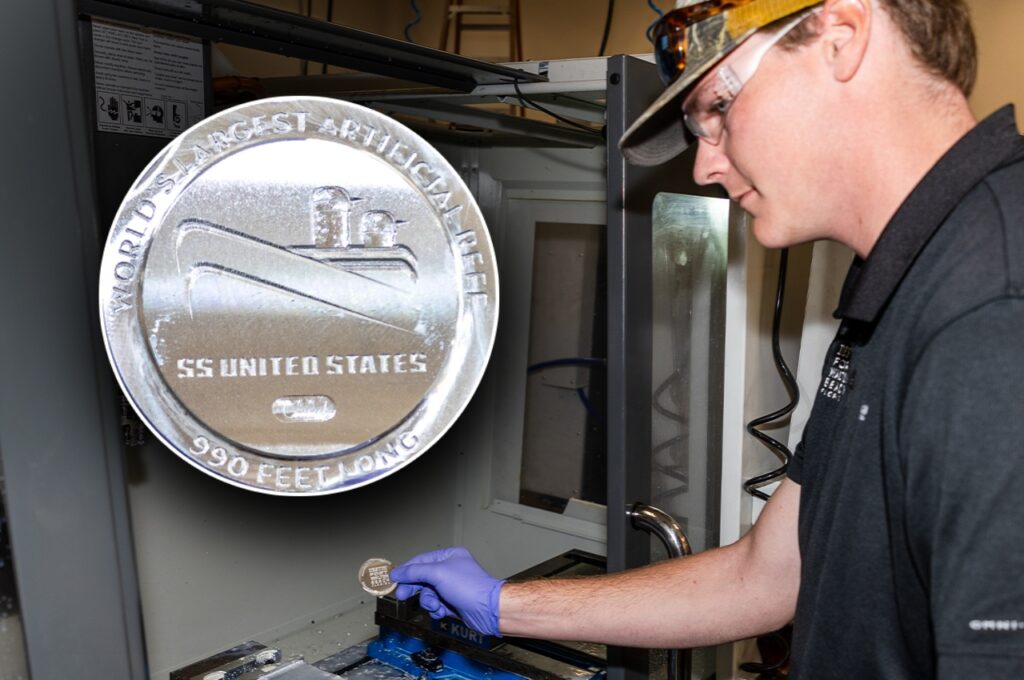
“Microbes are everywhere. They’re ubiquitous. They’re probably gonna be the first things to colonize the wreck,” Meyer-Kaiser said. Based on comparable studies using metal test discs placed on artificial reefs, she expects biofilm to develop within weeks to months.
That biofilm matters because it produces chemical cues that influence which invertebrate larvae, drifting through the water in search of a suitable habitat, will settle on the structure.
- “When invertebrate larvae are drifting along in the ocean, dispersing to their new habitat, they’re smelling the water and they’re looking for chemical cues that indicate this is a good place to live,” Meyer-Kaiser said. “So how that biofilm takes shape influences what is going to settle there in terms of the sponges, the corals, the anemones.”
She expects the reef to eventually support gorgonian sea fans, soft corals and other filter-feeding organisms, particularly on the upper portions of the wreck where currents are stronger.
Meyer-Kaiser compared it to a conveyor belt sushi restaurant: organisms that can position themselves higher on the structure are exposed to faster-moving water, bringing more food past them per unit of time.
“When you get a massive shipwreck like SS United States, those upper portions are going to be exposed to really swift current,” she said. “I anticipate that we’re gonna have a lot of things wanting to live on the upper portions of the wreck because there’s a lot of food for them there.”
A self-contained experiment
The vessel’s unusual construction, a steel hull paired with aluminum decking and superstructure components, gives researchers a built-in comparative study that most artificial reefs can’t offer.
Iron from the steel hull plays a role in photosynthesis and some research suggests it may help corals withstand higher water temperatures, though too much iron can become stressful. Meyer-Kaiser compared it to taking multivitamins: beneficial within a certain range, but potentially harmful in excess.
- “There are some experiments showing that when corals live in iron-rich waters, they’re able to withstand higher temperatures better,” she said.
Aluminum, by contrast, has no known biological function and can stress organisms at relatively low concentrations, she said. Meyer-Kaiser said she has a paper currently in press comparing World War II-era iron shipwrecks with an aluminum airplane in the Tropical Pacific. The iron vessels supported dense, diverse coral communities, while the aluminum aircraft was sparsely colonized.
“This is a chance to look at that within a single vessel and really dial into that physiology and the chemistry to try to understand the impact of those metals on the organisms that are gonna live on SS United States,” she said.
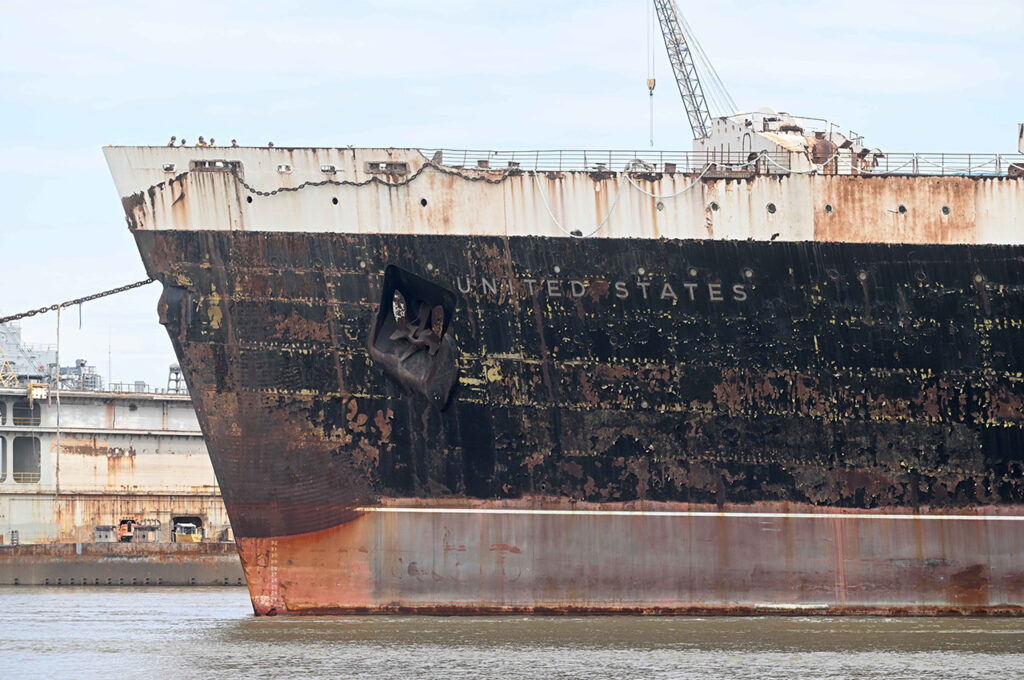
The team’s chemical monitoring will also include tracking how metals from the vessel’s coatings and structure behave in the surrounding water column over time. That includes monitoring chromium speciation, a topic that has drawn public attention due to zinc chromate primer coatings applied to the ship during its original construction in the early 1950s.
Meyer-Kaiser said her team plans to include chromium in its chemistry analysis as part of the broader research into how the ship’s materials interact with the developing ecosystem.
Okaloosa County is following all regulatory guidelines outlined by the EPA, Army Corps of Engineers and other regulatory agencies, based on county documents. In addition, all peeling and exfoliating paint has been removed during the remediation process in Mobile.
A new field of science
The SS United States project advances what Meyer-Kaiser and collaborators have termed Maritime Heritage Ecology, an interdisciplinary field combining marine biology and maritime archaeology to understand the role shipwrecks play in ocean environments.
Meyer-Kaiser co-developed the field with archaeologist Calvin Mires after the two worked together on shipwrecks in Stellwagen Bank National Marine Sanctuary off Massachusetts in 2019.
- “We had this collective light bulb that there was a dramatic need for biology-archaeology collaborations to really understand the role that shipwrecks play in the ocean environment,” she said. “There is an indelible human footprint on the sea floor that is only increasing over time.”
The core thesis: biological change on a shipwreck is coupled with the physical and chemical changes to the wreck itself. On wooden shipwrecks, for example, the arrival of shipworms leads to structural degradation over time. On the SS United States, that coupling is expected to center on the vessel’s chemistry.
Research partners and funding
WHOI is not alone in studying the vessel.
A team from the University of Southern Mississippi, led by microbiologist Dr. Leila Hamdan, has already conducted an initial expedition to collect sediment cores and water samples from the deployment site before the ship arrives, establishing a “before” snapshot for comparison.
That work is funded through the NOAA Ocean Exploration Cooperative Institute. Other research teams include Dauphin Island Sea Lab, which is studying changes in the underwater soundscape, and Louisiana State University, which will examine fish interactions with the reef.
Funding for WHOI’s first two years of research is secured through grants. Meyer-Kaiser said sustaining the project through a full decade will require ongoing proposal submissions to agencies including the National Science Foundation and NOAA.
Long-term vision
Beyond the core research, Meyer-Kaiser envisions the SS United States eventually serving as a platform for permanent ocean-sensing equipment such as temperature and salinity sensors and underwater cameras. She also hopes to develop a citizen science program that would enlist recreational divers as monitors.
- “Suppose you want to put energy infrastructure in the ocean. Something is going in anyway, but you want to make it as positive for biodiversity as you can,” she said. “Learning what we can from shipwrecks and from artificial reefs will inform better design of other built infrastructure so that we can actually have a net positive impact on ocean biodiversity.”
She called it nature-positive design, and said the lessons learned from the SS United States could shape how humans build in the ocean for decades to come.
For Meyer-Kaiser, the project is also deeply personal. She first learned about the SS United States deployment at a WHOI donor event, where a supporter noticed her research poster on shipwreck ecology and mentioned the project. She immediately reached out to Okaloosa County and worked her way to Fogg, driven by what she called a once-in-a-career chance to understand an ecosystem from the very beginning.
“We’re going to be able to answer a lot of really cool maritime heritage ecology questions with the multidisciplinary data that we can get from the ship,” Meyer-Kaiser said. “It’s going to be phenomenal.”

One Response
My understanding is that the mission of Woods Hole is to advance scientific knowledge and safeguard the health of our oceans. Given that mission, it is difficult to reconcile an apparent willingness to observe the reefing of the SS United States while potential contaminants including zinc chromate coatings and questions surrounding long-term aluminum degradation remain unresolved.
To many of us, this appears fundamentally inconsistent with the institution’s stated purpose. Rather than passively documenting the environmental consequences of a project that may introduce avoidable pollutants into the marine ecosystem, Woods Hole should be among the leading voices advocating for the highest standards of environmental stewardship and precaution.
I also find it difficult to understand how Dr. Meyer-Kaiser could express enthusiasm for studying what may become a preventable environmental hazard. Scientific curiosity is invaluable, but it should never be viewed as a substitute for preventing environmental harm when prevention remains possible. The more ethically and morally responsible course would be to oppose the reefing of the SS United States and instead support preservation or another environmentally responsible alternative that avoids introducing unnecessary risks to the marine environment.
Institutions whose mission is the protection and understanding of our oceans carry a special responsibility not only to study environmental impacts, but also to advocate for preventing them whenever practical. That leadership is what many of us expect from Woods Hole.