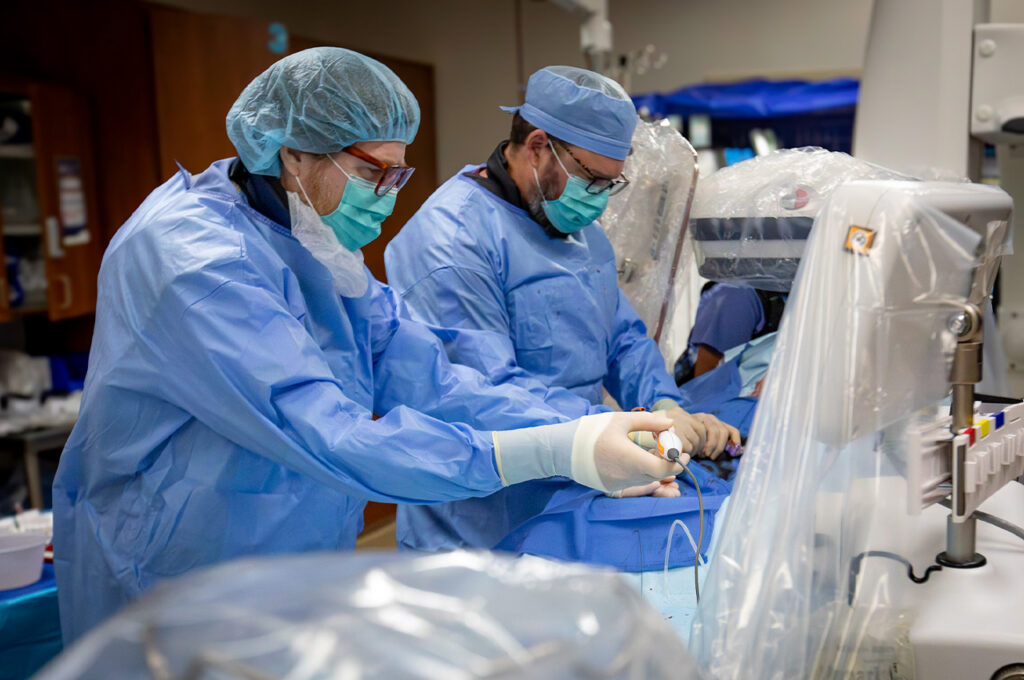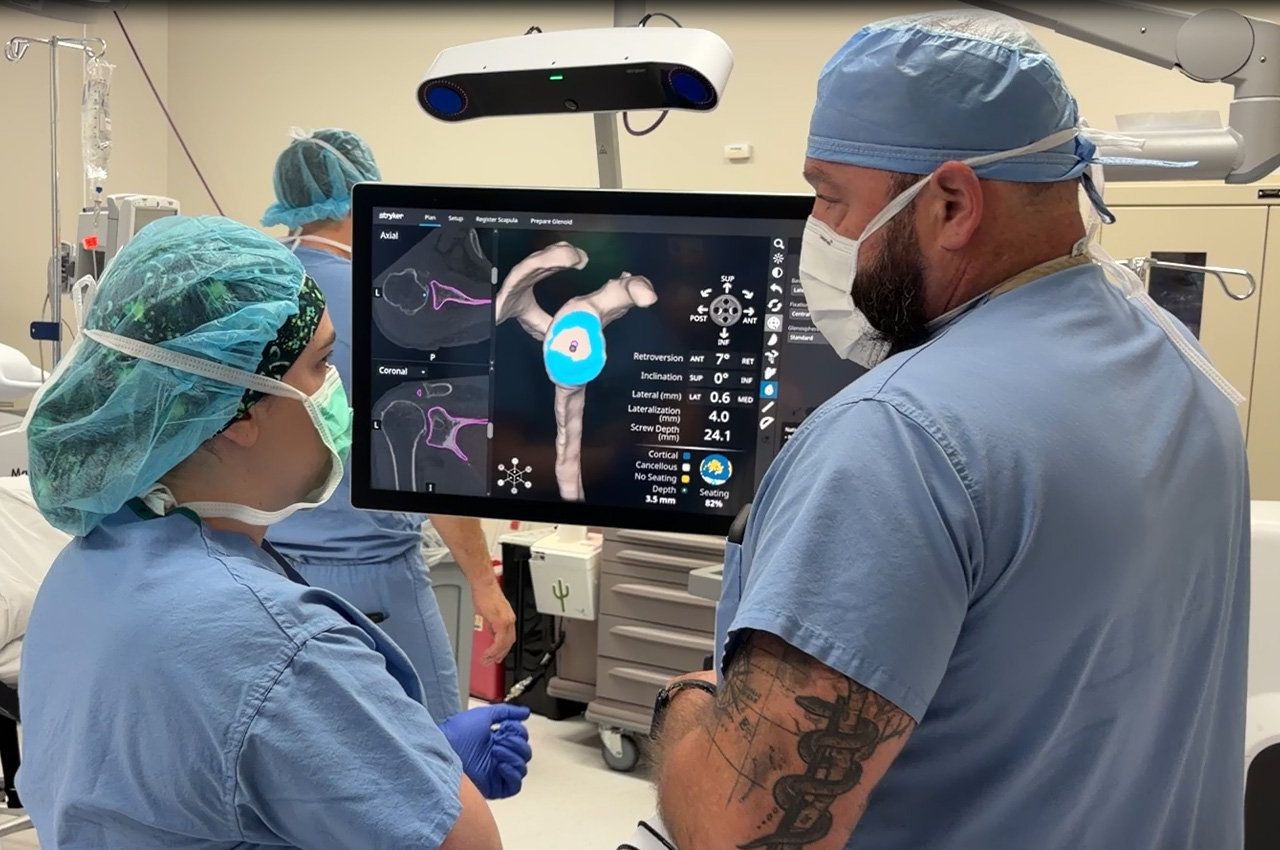
Dr. David Dean, one of the first 20 surgeons in the country trained on newly FDA-cleared robotic shoulder replacement technology, completed two procedures Monday morning at HCA Florida Fort Walton-Destin Hospital, making it the only facility between Tampa and Texas currently offering the technology.
- Dean, a board-certified orthopaedic surgeon at Orthopaedic Associates, used Mako Shoulder SmartRobotics technology to perform the total shoulder replacements.
The FDA cleared the technology for commercial use last Wednesday, and Dean said he was told by company representatives that his first procedure Monday was the first performed across the Gulf Coast region.
“I couldn’t have asked it to go any better,” Dean said. “The staff was ready. The representatives from the company were here to assist, and it went extremely smoothly.”
Dean was selected for the first national class of roughly 20 surgeons trained on the shoulder application. He has used the Mako system for knee replacements for seven years and is also certified in its hip replacement application.
That experience, he said, made the transition feel natural.
- “A lot of the early adopters around the country are going to be shoulder-only surgeons,” Dean said. “I’m one of the few that also has certification in the knee and the hip. So when I went to the training, it was just natural for me because I understood it.”
The training itself included lectures, online modules and two mock procedures, one on a model and one on a cadaver.
The robotic system allows surgeons to build a patient-specific surgical plan from a 3D CT scan before entering the operating room. During the procedure, it provides real-time guidance and uses AccuStop haptic technology to help the surgeon stay within planned boundaries. The surgeon remains in control throughout.
Dean said the technology allows precision within half a degree of the planned implant orientation, a level of accuracy the human eye cannot match.
“Every human being is just a little different,” he said. “When you do it in traditional ways, you can’t appreciate that. The human eye can’t measure a one-degree difference in the orientation of the bone or the orientation of the joint.”
With the robotic system, the entire procedure can be planned and reviewed on-screen before anything is done to the patient. Dean said that level of control changes the way a surgeon approaches the work.
- “You can plan the whole surgery, you can look at it on a screen, and everything you want before you ever do anything to the patient, you have chosen, you’ve selected,” Dean said. “And then once you’re happy with it, you lock it in and that is what the final result is going to be.”
The first procedure added roughly 10 minutes to the overall surgical time, which Dean attributed to first-time logistics, such as adjusting the table position relative to the robot and the way the surgical team stands around the table, rather than the surgery itself.
Recovery time, he said, is unlikely to change in the short term because the surgical steps and tissue work remain the same. But he said improved implant accuracy should theoretically lead to faster healing, better range of motion and greater strength. It may also extend the life of the implant.
“If you put an implant in and you’re just a degree or two off, you can’t change it once it’s in,” Dean said. “You don’t even know from traditional ways until you take an X-ray after surgery.”
Darren Harris, executive director of Orthopaedic Associates, said the addition of robotic-assisted shoulder replacement reflects the practice’s approach to adopting proven advances in orthopaedic care.
- “As new technologies become available, our physicians are committed to obtaining the specialized training needed to offer those advancements to our patients,” Harris said. “Mako SmartRobotics for shoulder replacement is another example of that commitment.”
Dean said the investment by HCA Florida Fort Walton-Destin Hospital made the procedures possible locally.
“It’s both flattering and exciting,” Dean said of being among the first surgeons in the country to use the technology. “I’m glad that they had the faith in me to do it.”
KC Donahey, CEO of HCA Florida Fort Walton-Destin Hospital, said the addition of robotic-assisted shoulder replacement reflects the hospital’s focus on expanding access to advanced care in the region.
“Introducing this advanced robotic technology for shoulder replacement demonstrates our dedication to delivering exceptional orthopaedic care close to home,” Donahey said. “By investing in leading-edge technology and partnering with highly skilled physicians, we are helping provide patients with a more personalized surgical experience and the highest level of precision available.”
Dean said he expects the technology to improve rapidly, pointing to how far the Mako system has come in the seven years he has used it for knee replacements.
“Even the robotic surgery for knees seven years ago to today is so much better and even more accurate,” he said. “With the shoulders, I suspect it’s going to go that same way, but only faster.”
He said surgeons who do not adopt the technology risk falling behind.
“If you don’t adopt technology, you’re going to be stuck in old ways and never want to strive for better,” Dean said.
Orthopaedic Associates’ shoulder team also includes Dr. Mark Tenholder and Dr. James Watt. Dean sees patients at the practice’s offices in Crestview, Fort Walton Beach and Destin.