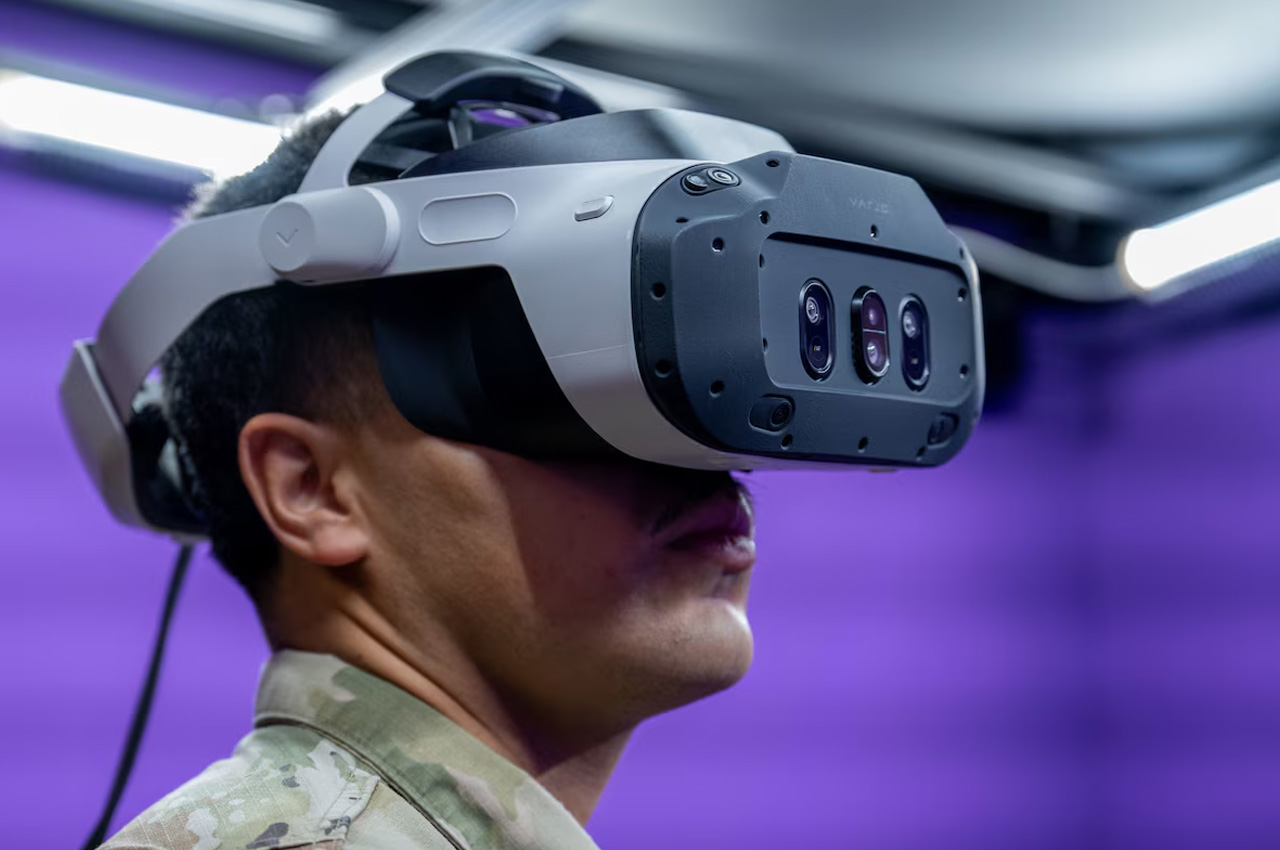
The 1st Special Operations Wing has introduced virtual reality simulator training for air traffic controllers at Hurlburt Field, a move aimed at reducing upgrade training time and maintaining mission readiness across Air Force Special Operations Command.
- The VR system, introduced on June 9, provides controllers with a high-definition view of the airfield and can replicate dynamic weather changes, low-visibility scenarios and emergency situations. The system offers a full 360-degree field of view, allowing trainees to scan the airspace by turning their heads while keeping their hands free to perform other tasks.
“Scaling these VR learning environment capabilities AFSOC-wide will undoubtedly produce more resilient, self-correcting controllers,” the wing’s ATC training and standardization noncommissioned officer in charge said. “This early testing enhances the 1st SOW’s mission readiness with increased agility, enabling our controllers to master new procedures and terminology well before the real-world changes take effect.”
The technology shifts training from passive observation to active participation, allowing airmen to repeatedly practice realistic scenarios without relying on live airfield operations. It also gives supervisors a new tool to evaluate performance.

“VR equipment bridges a critical gap in spatial awareness and operational fluidity,” the NCOIC said. “It fully immerses trainees in a realistic environment with a true 360-degree field of view.”
The system also introduces greater flexibility in scheduling. An ATC airman directly attached to the training curriculum said trainees will eventually be able to run exercises independently when a trainer is unable to step away from operational duties.
- “It allows for more flexibility on when training can be accomplished when real-life scenarios are not readily available,” the airman said.
An ATC apprentice said the VR simulation allows trainers to observe how trainees react to realistic scenarios and identify areas for improvement.
“As a Senior Airman looking toward a future as a staff sergeant and supervisor, I can use this technology to help trainees develop confidence and decision-making skills in a safe training environment,” the apprentice said.
With the initiative, the 1st Special Operations Wing aims to train highly proficient controllers faster and with greater operational adaptability. The effort could serve as a blueprint for modernized ATC training across AFSOC, potentially shaping how all wings under the major command conduct airspace operations.