
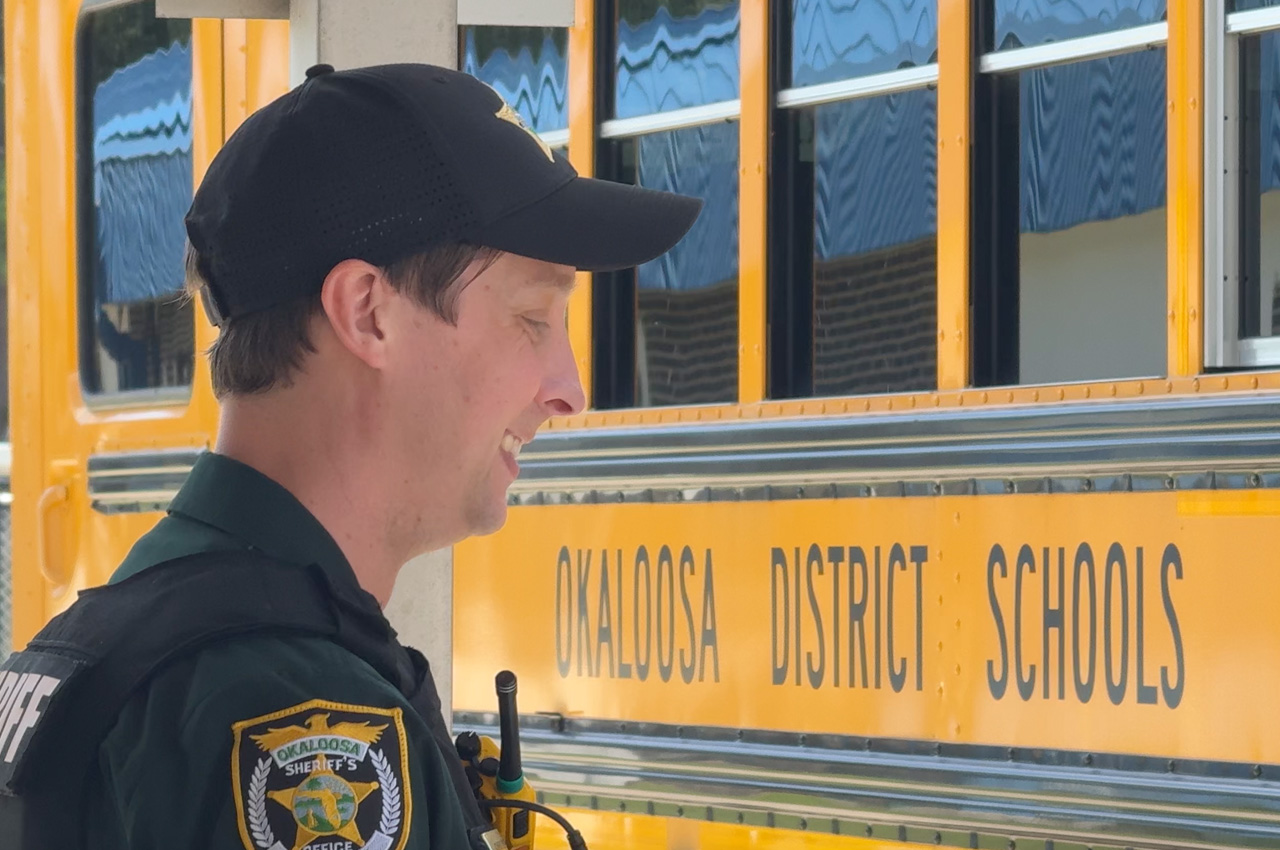
Okaloosa County Commissioners voted 3-2 on Tuesday to reduce the county’s contribution to the school resource officer program by $500,000 in the coming budget year, a compromise that pulls back from a proposal last month to eliminate the county’s $4.4 million share entirely.
- In the same discussion, the commission voted unanimously to direct staff to develop a two-to-three-year plan to phase down the county’s contribution further, with the goal of an even split with the Okaloosa County School District once state Safe Schools funding is set aside. A third motion, to lower the county’s property tax rate by a corresponding $500,000, failed 4-1.
The votes marked the first concrete action on a funding question that has run through the county’s budget process and included debate at the commission’s July 21 budget workshop, where commissioners deadlocked over whether the county should keep funding half of the program.
Chairman Trey Goodwin, who brought the item forward, said he had met since that workshop with Superintendent Marcus Chambers, School Board member Brett Hinely and Sheriff Eric Aden to look for common ground. He said he went into the meeting seeking a $2 million reduction and came out at $500,000.
“I asked for two, they asked for zero. We come at $500,000. They out negotiated me,” Goodwin said. He framed the result not as a victory for either side but as movement. “It’s not whether or not this is a win for the county or a win for the district. The question is, is it progress, and does it reduce safety?”
Goodwin said no one in the meeting wanted to move away from the sheriff’s office as the provider of school security. “The people protecting our kids, they need to be in a green uniform, and they need to have Okaloosa County Sheriff’s Office on that uniform,” he said.
Okaloosa Commissioners set tentative millage rate, debate future of school resource officer funding
Okaloosa commissioners debated the county's SRO funding arrangement with the school district before voting 4-1 to hold the property tax millage rate steady.
What the reduction does
The $500,000 reduction does not shrink the SRO contract itself. As Aden explained to the board, the motion changes who pays rather than the level of service.
“It’s been a shared partnership, and it still sounds like it’s gonna be a shared partnership,” Aden said. “The motion is who’s paying for what.”
Cox asked whether the change could cost schools any officers. Aden said the number of SROs would not change as long as the full contract amount is still met. But if the school district does not cover the $500,000 the county is stepping back from, he said, the service would shrink by that amount.
- “If there’s a $500,000 reduction in the product that we serve, then there’s a $500,000 reduction we would have to do in what we offer to the school system,” Aden said.
Commissioners Drew Palmer and Goodwin both noted that state law requires a safe-school officer at every school, and said the board should trust the district to meet that obligation.
A partnership that dates to Parkland
The county’s role in the program dates to 2018, when the Legislature passed Senate Bill 7026 in the weeks after the shooting at Marjory Stoneman Douglas High School in Parkland. The law, effective March 9, 2018, placed responsibility for school safety officers on Florida’s 67 school districts. The county entered a 50/50 cost-sharing arrangement with the district beginning in fiscal year 2018-19.
Documents in the commission’s agenda packet detail the full cost for the coming year. A School District analysis dated July 28 puts the total SRO contract at $8,831,304 for fiscal year 2026-27. The county and sheriff’s office cover $4,415,652. The district’s share is made up of $2,731,129 in state Safe Schools funding, $1,459,997 from its general fund and $224,526 from charter schools.
Commissioner Paul Mixon, who has argued the arrangement is no longer balanced, said the county has contributed $28,769,817 to the partnership over nine years. He said his objection was not to the program but to the principle.
- “It’s not an issue of quality of service,” Mixon said. “It’s an issue of fundamental responsibility.”
The Safe Schools question
Much of the debate turned on the state’s Safe Schools allocation. The county and district describe the money the same way, but draw opposite conclusions from it.
The School District’s own analysis in the packet states that the Legislature created the Safe Schools allocation in 2018 by reducing school district operating revenue and moving it into the categorical, and that the money is therefore not additional revenue. Goodwin, reading from the statutes during the meeting, reached a similar description, noting the allocation is created under state law with a priority that it be spent on safe-school officers, and that the money comes from the state rather than the district’s property taxes.
Where they differ is what that means for the split. Commissioners have argued the allocation should be set aside as the district’s contribution before the remaining cost is divided evenly, which would shift more of the contract onto the district. District officials have said the money should not be treated as reducing the county’s obligation, since it was taken from their own operating budget.
- Under the current split, Goodwin said, the county carries about 50% of the cost, the district about 17.5%, charter schools about 2.5% and the state about 30%. He said the $500,000 change would move the county to roughly 44% and the district to about 24%, leaving the county carrying the largest share.
Okaloosa School District explains how Safe Schools funding works amid county SRO debate
Nearly a week after county commissioners questioned their share of the cost, district officials set aside money for a potential increase and explained how they fund their half.
County Administrator John Hofstad said the discussions traced back to last year, with his first face-to-face meeting with the superintendent on Oct. 13. He said his own recommendation had been to take the Safe Schools allocation off the top of the $8.8 million contract and split the remaining roughly $6 million evenly, which would have reduced the county’s contribution by about $1.6 million in the first year.
“That’s something I can live with,” Hofstad said of the $500,000 figure. “A $500,000 reduction on our end as a contribution is a starting point.”
Hofstad said the smaller reduction would not require dipping further into reserves, and that a $500,000 cut was “insignificant in the grand scheme of things” for a budget exceeding $700 million.
The no votes
Cox and Ketchel cast the two votes against the $500,000 reduction.
Cox said she could not support restricting the SRO budget this year on such short notice, with the school year set to begin in less than a week. She pointed to the district having already closed two schools amid its own budget pressures, and pressed Aden on whether the reduction could cost the high schools any of their officers.
Ketchel said she supported the county paying a smaller share but opposed the timing, saying the district was not prepared to absorb the cost this year. She said she had spoken with Chambers several times and intended to put the district on notice for next year.
- “I’m very much in favor of school resource officers. What you all do is amazing,” Ketchel said. “But it’s only fair that we pay a lesser amount.”
She warned that if the November homestead exemption passes, the county would face far harder choices, weighing SRO funding against services such as mosquito control and veteran services.
Mixon, who has pressed hardest on the question of responsibility, voted for the reduction but said he had wanted a larger one, closer to the roughly $1.6 million Hofstad had outlined. He also pushed back on any suggestion the timing was a surprise to the district.
“This is not a surprise,” Mixon said. “Notice was given in October of last year with a face-to-face meeting.”
The tax question
The third piece of the plan, and the only motion to fail, was Goodwin’s proposal to return the $500,000 to taxpayers by lowering the county’s millage rate proportionally. Hofstad said the reduction would have moved the rate from 3.8308 mills to 3.8149 mills.
Goodwin argued the giveback would show taxpayers the county was not cutting its SRO support to free up money for other uses. Mixon objected to changing the rate, citing a budget that already draws from reserves. Ketchel said she could not tell constituents the county had reduced its school resource officer funding by $500,000 and lowered their property taxes in the same move. The motion failed with Goodwin the only vote in favor, leaving the millage rate unchanged even as the SRO reduction stands.
Palmer, who made the original motion, said he was not enthusiastic about the compromise but viewed it as an incremental step. “I’m not a huge fan of this motion, but I see it as an incremental win,” he said.
The school board’s side
The district signaled its own preparations at their July 27 budget workshop. Chief Financial Officer Julie Perry told the School Board she had set aside $1.6 million in the proposed budget as a potential need for the SRO contract, a figure she said could climb to about $4.4 million if the county eliminated its share entirely.
Perry said Safe Schools money is not a grant or extra funding but dollars the state shifted out of the district’s operating budget in 2018. Board members repeatedly credited the county for the partnership.
Board member Lamar White recalled former Sheriff Larry Ashley telling the board that students are county citizens who deserve protection, and Chambers said the county’s decision to enter the 50/50 split allowed the district to place officers in every school, with two in each high school.
Vice Chairman Parker Destin said he hoped the county would keep the program in its budget, and Hinely volunteered to represent the board in talks with the county.
What comes next
The county will not adopt its budget until the fall, and the reduction now turns the question to the school board, which must decide whether to cover the $500,000 the county is stepping back from. Aden told commissioners that if the district does not, the sheriff’s office would have to cut SRO service by that amount.
In a statement provided to Get The Coast, the Okaloosa County School District said they remain “fully committed to providing a safe and secure learning environment for every student and employee.”
- “The District is committed to ensuring that School Resource Officers remain an integral part of our school safety plan. We will continue working collaboratively with our community partners to ensure our schools have the resources necessary to protect and support our students and staff. Our School Resource Officers are valued members of the OCSD family, and we are grateful for their unwavering commitment to keeping our school campuses safe.”
Ketchel asked that the county’s intent to seek a larger reduction next year be put in writing to the School Board. The phased plan the board approved unanimously directs staff to return with a framework for reaching an even split after Safe Schools funding within two to three years, a target commissioners noted a future board could change.



2 Responses
The county has to find the $$ somewhere, just like everyone else.
Every thing is so expensive bc of the pointless Iran War, tariffs, and other emotional economic policies driving up the costs of everything.
My question is: why are we taking it out of the hides of our children’s schools when we should be banging on Patronis’ door?
He needs to reign Trump in and focus on affordability in America – not fighting Israel’s wars for them.
way to address the issue directly!