

Okaloosa County Administrator John Hofstad gave commissioners a closer look Tuesday at which parts of the county’s proposed General Fund budget are mandated, necessary for general government operations or considered quality-of-life services.
- The Aug. 18 presentation continued a series of budget discussions the Board of County Commissioners has held in recent months as county officials consider the potential effects of the proposed constitutional amendment that would reduce property tax revenue.
What the amendment would do
Titled “Save Our Homes from Excessive Property Taxes,” HJR 1F would raise the homestead exemption for all levies other than school district levies to $150,000 beginning Jan. 1, 2027, and to $250,000 beginning Jan. 1, 2028. The amendment also requires the legislature to provide, through general law, a schedule for full elimination of property taxes on homesteads.
People who establish Florida residency after Jan. 1, 2027, would receive a $50,000 exemption initially and would not qualify for the full exemption amount until their fifth year, unless a county or municipal governing body votes by a two-thirds majority that a shorter period is warranted for a critical local need.
- The amendment would also lower the cap on annual assessment increases for non-homestead residential property of nine units or fewer, and for other non-homestead real property, from 10% to 5% starting Jan. 1, 2027.
The amendment also restricts how counties and municipalities may use ad valorem tax revenue, limiting it to public safety, education, infrastructure, natural resources, debt service, retirement obligations for local government employees, and operations of county officers and governing bodies.
RELATED:
- Okaloosa administrator says property tax amendment could cut $24 million from county budget by year two
- Okaloosa County proposes $769 million budget for fiscal year 2027 with no millage increase
- Okaloosa commissioners to explore penny sales tax initiative that could replace homestead property taxes
- Okaloosa commissioners set tentative millage rate, debate future of school resource officer funding
Three categories…
Hofstad described mandated services as those generally required by state law, Florida Administrative Code or other legal requirements; general government services as essential functions needed to operate county government; and quality-of-life services as those that are not expressly required.
The county’s written agenda item similarly defines mandated expenditures as constitutional, statutory, administrative or court-related obligations. General government includes administrative functions that are not expressly mandated but are considered necessary for county operations, while quality-of-life expenses include services such as parks, the Library Cooperative, Veterans Services, Extension Services and housing.
According to the county’s analysis, the proposed $191.1 million General Fund budget includes approximately $172.2 million categorized as mandated, $8.1 million as general government and $10.9 million as quality of life.
Hofstad cautioned that the analysis was not a detailed examination of every individual expenditure within the budget.
- “This is a high-level view,” Hofstad said. “Obviously, we did not go into line item detail and break out each line item within your budget.”
The analysis comes as county officials continue discussing Amendment 3 and its potential impact on Okaloosa’s property tax collections as they continue to work through this budget cycle. Hofstad told commissioners Tuesday that the county is estimating a reduction of about $15 million in the first year and nearly $25 million in the second year if the amendment is successful.
The breakdown
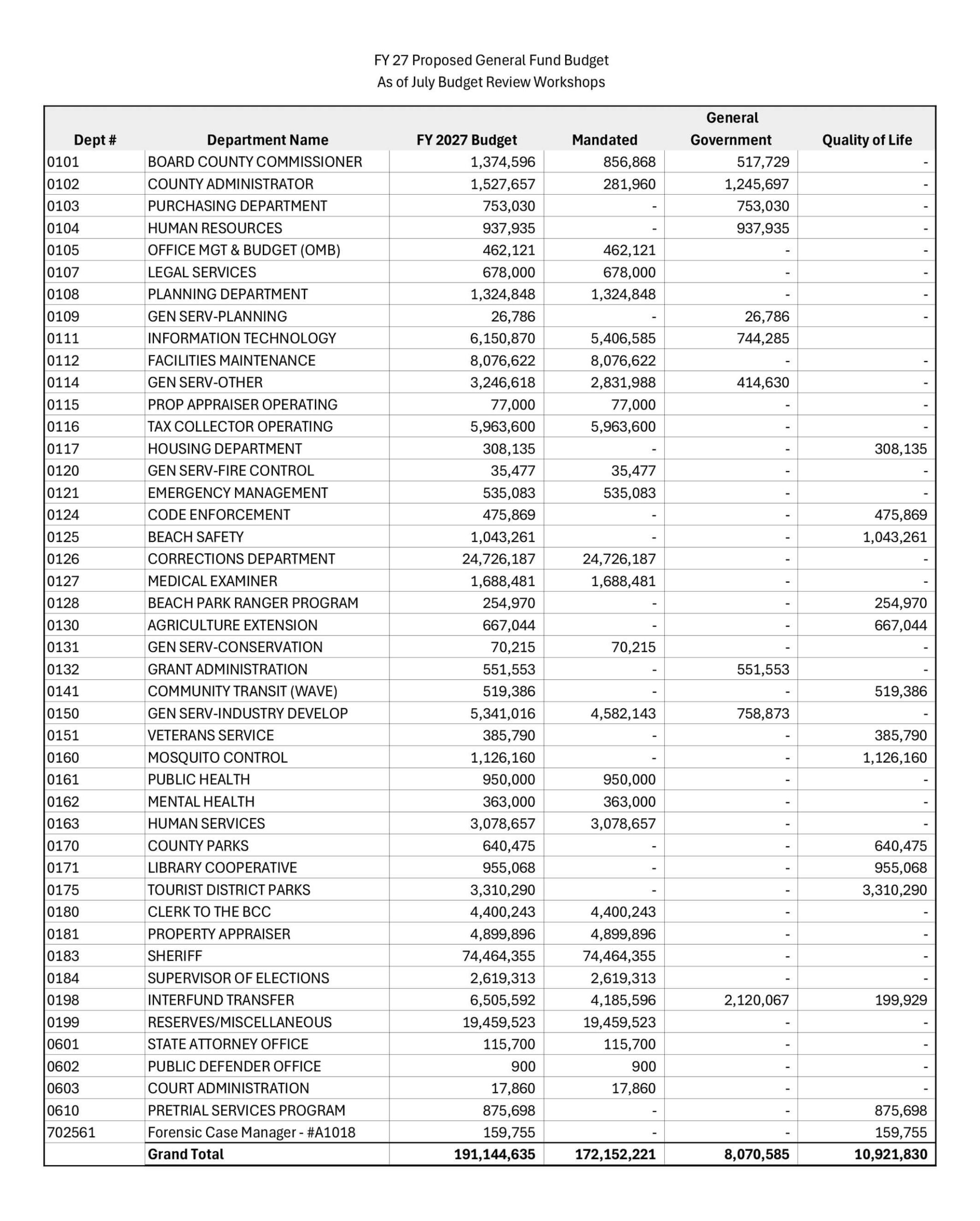
According to Hofstad, the purpose of the new breakdown was to illustrate how much of the General Fund supports services the county considers mandated or essential.
“As you can see, the mandated services, they compile the majority of the expense that we utilize – majority of our property tax revenue,” Hofstad said.
Among the largest expenditures the county classified as mandated are approximately $74.5 million for the Sheriff’s Office and $24.7 million for the Corrections Department. The county also placed Facilities Maintenance, the Tax Collector, Property Appraiser and Clerk to the Board of County Commissioners in the mandated category.
Hofstad pointed to public safety and corrections while explaining the mandated portion of the budget. He said counties have statutory responsibilities related to housing inmates before their cases are resolved.
- The county’s analysis placed a number of other services in the quality-of-life category, including housing, code enforcement, beach safety, the Beach Park Ranger Program, Agriculture Extension, community transit, Veterans Services, mosquito control, county parks, the Library Cooperative and Tourist District Parks.
However, Chairman Trey Goodwin asked Hofstad to clarify that the amounts shown in that column should not necessarily be interpreted as property tax or General Fund dollars being spent on each service.
Goodwin specifically pointed to Beach Safety, the Beach Park Ranger Program and Tourist District Parks.
“We’re not saying that we’re taking $3.3 million of property taxes and putting it into tourist parks,” Goodwin said. “That’s not what this is saying. I just don’t want anybody to get the wrong idea. Same for beach safety.”
Hofstad agreed and explained that some department budgets include multiple funding sources.
For example, Hofstad said tourism-related activities can be supported with Tourist Development District revenue where state law allows those funds to be used. He cited beach safety as one of those services.
- “Obviously, beach safety is cornerstone to that, so that’s why we’ve been able to tap into that funding source to offset it,” Hofstad said.
Hofstad also told commissioners that categorizing a service as mandated, general government or quality of life does not necessarily mean an entire department would either be preserved or eliminated if budget reductions were required. Instead, he said the county could have to examine individual expenses within department budgets.
Using parks and facility maintenance as an example, Hofstad said the county has responsibilities to maintain its facilities, but could consider whether some work could be performed less frequently.
“Is it important or is it absolutely necessary that we mow grass every two or three weeks, or do we have to scale back on that type of operation?” Hofstad said.
He offered a similar example involving the county’s Information Technology budget. According to the county’s analysis, approximately $5.4 million of the $6.15 million IT budget was classified as mandated, while about $744,000 was categorized as general government.
Hofstad said certain cybersecurity and technology requirements are necessary for county government, while other expenses could potentially be delayed if the county needed to reduce spending.
- “Do we have to continue with a scheduled every-other-year replacement of PCs and laptops? No, we don’t necessarily have to do that,” Hofstad said. “That’s something we could push down the road.”
Hofstad also said software purchases could be reviewed, noting that software can reduce manpower needs and make county operations more efficient but also carries upfront and annual maintenance costs.
Those examples were not proposed budget cuts. Hofstad presented them as examples of the types of individual expenses staff could examine if significant reductions became necessary.
“If we just look at your general government services and your quality of life services, we can’t make up that deficit by cutting out those levels of service without impacting in some form or fashion those mandated services that we provide as part of our county government,” Hofstad said.
Commissioners discuss county reserves
The discussion also turned to the county’s reserves and whether they could be used to offset reductions in revenue.
Hofstad said the county has worked over the past 10 years to build its reserves and has adopted an internal policy governing reserve levels. He recalled that around 2014-2015, the county had approximately $4 million in reserves, which he said would not have been enough to maintain county operations following a disaster.
“While we have that reserve figure there, that’s not something I would typically go and continue to reduce that reserve and get us back in the same position we were 10 years ago,” Hofstad said.
Goodwin said the county’s reserves serve multiple purposes, including money set aside for known future maintenance or replacement costs and funds available to maintain operations following an unexpected disaster.
He compared using those reserves for routine operating expenses to a homeowner spending money saved for a future roof replacement on monthly expenses.
- “If you start using that money to pay your light bill, you’re going to have a problem,” Goodwin said.
Goodwin also cited the experience of Bay County following Hurricane Michael, noting that federal reimbursement following a disaster is not immediate. He said the county reserves help ensure services such as public safety and Public Works can continue operating during that period.
Commissioner Carolyn Ketchel said the county has been fiscally conservative in building its reserves and expressed concern about the choices commissioners could face if property tax revenue declines.
She specifically mentioned mosquito control, which is listed at approximately $1.1 million in the county’s quality-of-life category.
- “I’d hate to think that this homestead exemption would pass and we’d have to decide not to have mosquito control,” Ketchel said. “Can you imagine living here without mosquito control?”
Ketchel also mentioned animal control while discussing services that could face budget pressure.
The mandated-versus-quality-of-life analysis was requested following the July 21 budget review workshop and was presented for commissioners’ consideration as they continue working through the proposed fiscal year 2027 budget.
Goodwin said presenting the budget in the three categories gives both commissioners and the public a clearer snapshot of how county services are funded and classified.
“I think it’s good information that we all keep at the forefront of our minds as we’re finishing up our budget cycle here,” Goodwin said. “When we kind of condense it down like this, I think it makes it easier for our public to kind of get a snapshot of what we’re looking at and be able to see some of those numbers.”


2 Responses
Brown flag, is needed. Please get on this.As for public safety. Thanks for your dedication.
Please consider, brown flag. To ensure people are warned ahead of existing pathogens and bacteria. TDC has funds available. Thank you.