
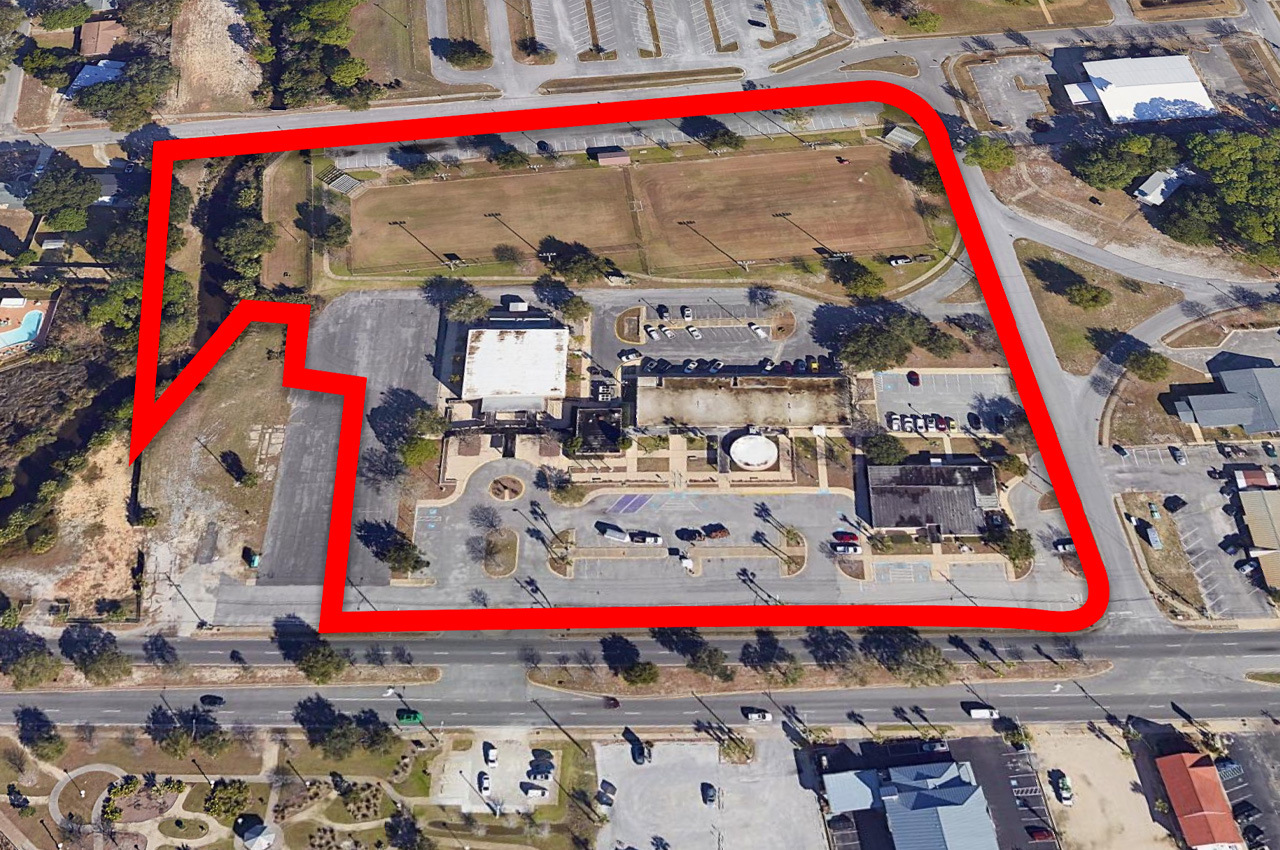
The Fort Walton Beach City Council voted 6-1 on Aug. 25 to approve using $3.87 million from the city’s Cemetery Perpetual Care Fund to purchase and extinguish a reverter clause on the City Hall property, settling pending litigation with the Jackson Land Trust and giving the city unrestricted ownership of the roughly 9-acre site at 107 Miracle Strip Parkway SW.
Councilman David Schmidt made the motion, which was seconded by Councilman Bryce Jeter. Councilman Payne Walker cast the lone dissenting vote.
What is a reverter clause?
A reverter clause is a deed restriction attached to donated property that can force ownership back to the original donor’s heirs if certain conditions aren’t met. The City Hall property was donated by the Jackson family, and the restriction requires it be used for city hall, an auditorium or parks and recreation purposes.
City Attorney Jeff Burns told the council the clause covers a portion of the property shaped like “an upside down seven,” encompassing the city hall buildings, the annex, part of the auditorium and the parking lot directly to the south. The Jackson Land Trust contends the clause covers the entire property, a dispute that would need to be litigated separately if not settled.
Under the terms of the deal, the Jackson Land Trust would release all claims to all the property. Once finalized, the city would own the entire parcel free of deed restrictions.
“Y’all could do what y’all want,” Burns said.
How the dispute started
The issue traces back to May 21, 2024, when the council unanimously directed staff to explore parking management at City Hall and look into potentially purchasing the reverter clause. At the time, businesses across Highway 98 were using City Hall’s parking lot, and the city was exploring whether to charge for parking or restrict access.
When that possibility was raised with the Jackson Land Trust, the trust sued the city, arguing the property was not being used for a public purpose.
- “They sued the city about 18 months ago, and they’re trying to enforce the reverter clause, which would result in the city losing title to this property,” Burns said.
The council then directed City Manager Jason Davis and Burns to negotiate a settlement. An independent appraisal valued the reverter interest at $3,870,000. A separate appraisal of the property’s highest-and-best-use value came back at approximately $9 million.
“We’ve done our due diligence, and just from an investment strategy, for paying $3.87M, the highest and best value came back at just under $9M” Davis said. “If you can double your money overnight, that’s called a jackpot.”
Where the money comes from
The $3.87 million would come from the city’s Cemetery Perpetual Care Fund, an investment fund built from cemetery plot sales and investment returns that is meant to sustain long-term maintenance of the city’s two municipal cemeteries, Beal Memorial Cemetery and Brooks Memorial Cemetery.
After the council voted on April 14 to pursue the purchase using cemetery funds, both city attorneys reviewed the legal viability and concluded the city should retain an independent financial expert to determine whether the fund held a genuine surplus above what is needed for perpetual care.
The city hired PFM Financial Advisors, which conducted an analysis of the fund’s balance, historical performance, projected maintenance obligations and long-term funding requirements. As of March 31, the fund had a balance of approximately $5.015 million, invested in a mix of equity mutual funds (60%), fixed-income mutual funds (39%) and cash.
PFM estimated the amount needed to sustain perpetual cemetery care at approximately $458,000. Combined with the $3.87 million reverter buyout, the total estimated funding requirement was approximately $4.16 million, leaving roughly $857,000 remaining in the fund.
The analysis also identified approximately $1.15 million in future cemetery capital improvement needs, including irrigation work, additional niches and visitor parking. City staff indicated those items are typically funded through the city’s annual operating budget rather than drawn from the perpetual care fund, and PFM did not include them as direct obligations of the fund.
Under PFM’s projections, the reverter buyout would be structured as an interfund loan, with the city’s general fund repaying the cemetery fund at a 3.53% interest rate over 20 years, with semi-annual payments beginning Jan. 1, 2028.
Davis noted the arrangement avoids the need for a bank loan.
- “If council’s direction is to go get a bank loan, then I’ll go get a bank loan,” Davis said. “We try to get creative here and solve the problem.”
The city also obtained a title opinion concluding that the reverter could impair the city’s ability to use the property as collateral and limit financing options for future improvements. A separate informal inquiry to a municipal financing company indicated construction financing could potentially be structured without buying out the reverter, but it would commit a portion of the city’s non-ad valorem revenues to debt service and reduce overall financial flexibility.
Walker’s opposition
Walker delivered pointed criticism of the deal throughout the discussion.
He argued the perpetual care fund belongs to the people who purchased cemetery plots and should not be used for an unrelated purpose, and that the $1.15 million in identified capital improvements would become a burden on taxpayers once the fund is drawn down.
“A $5 million perpetual care fund money being raided to buy out a reverter clause, which I still don’t believe that it’s required in order to get financing,” Walker said. “It happens all the time.”
Walker also challenged the strength of the Jackson Land Trust’s lawsuit, noting the city has not proposed changing the use of the property.
” think it’s a very weak case,” Walker said. “More negotiations are needed with the family and maybe revisit our willingness to let this matter go to court about the parking.”
He called the $3.87 million appraisal of the reverter interest “a taxpayer scam as far as I’m concerned.”
Supporters see a necessary step
Schmidt, who made the motion, outlined a broader vision for the property. He said removing the reverter clause opens the door for the city to potentially sell portions of the site, combine proceeds with revenue from other city-owned properties and use those funds to address the long-discussed question of what to do with City Hall.
“Carving up a portion of this property, getting it to the marketplace, the elderly services building that we got from the county, getting it to the marketplace, taking that funding to finally put some kind of closure to what we’re doing with City Hall,” Schmidt said.
Jeter, who seconded the motion, framed the vote as a prerequisite for any future action on the property.
“This is probably the single biggest step that we can take that’s either gonna make us do something on this property or make us sell this property and do something somewhere else,” Jeter said.
He also pointed to Okaloosa County’s experience with the Meigs Trust, in which the county litigated a similar reverter clause on the former Shalimar Courthouse Annex property for years before ultimately paying $1.6 million in 2013 to buy out that restriction on roughly 5 acres. The city manager’s memo noted that the Fort Walton Beach property is larger (over 9 acres), more than a decade has passed since the county’s deal and property values have increased substantially.
Burns confirmed.
“They had to go back and actually buy the reverter,” Burns said of the county’s experience.
Councilman Logan Browning said the condition of the current city hall buildings made action necessary.
“Not to build hotels or anything, but to build a new city hall,” Browning said. “This building needs something. I don’t know anything about conspiracy theories, but I know that there’s no theory that this building needs to be rebuilt.”
Mayor Nic Allegretto said he walked into the mayor’s office before the meeting to find a fan on the floor and a power pack stacked on top of office furniture because the room had flooded.
“If this is a step towards that, I commend you guys for doing it,” Allegretto said.
What happens next
Burns said the council will need to return for at least one more vote, likely at the Sept. 15 meeting, to pass a resolution formally changing the investment strategy of the cemetery trust fund. He said the Jackson Land Trust appeared to be moving quickly on the documentation needed to close, and the deal could potentially be finalized by the end of the fiscal year.
When asked whether the city intends to build a new city hall on the property or sell it, Davis left the decision to the council.
“If we build a city hall there, if we sell it, if we section it off in bits and pieces, I don’t care,” Davis said. “I don’t care where my office is.”
Burns said that decision would likely involve multiple workshops and public input.
“I think that’s a decision that y’all are gonna be making over the next couple years,” Burns said.



2 Responses
Mr. Walker… what I’m reading is: “Under PFM’s projections, the reverter buyout would be structured as an interfund loan, with the city’s general fund repaying the cemetery fund at a 3.53% interest rate over 20 years, with semi-annual payments beginning Jan. 1, 2028.” So it will be paid back.
What I don’t like is the ability of City to sell off this property.
They should not be allowed to sell off the property. We do not need another hotel or apartment buildings. Behind city hall we have a neighborhood and city athletic fields. LEAVE IT ALONE PLEASE